|
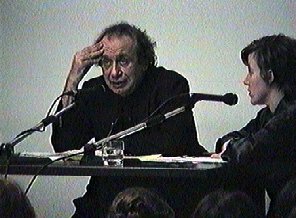 I'm going to talk tonight about only the last seven or eight years of work, work that is probably more architecture than art. In these years I've worked more the way an architect works than the way an artist works. So it is difficult to say "I" when I talk about the work, because there are three people who work for me full-time, and we work like an architect's studio. The work comes not so much from Vito Acconci, but from Acconci Studios.
What I'm going to try to deal with tonight are some notions of public space. I want to read some excerpts from essays that I've written over the past few years, then show some pieces that might act as examples of those essays.
I'm going to talk tonight about only the last seven or eight years of work, work that is probably more architecture than art. In these years I've worked more the way an architect works than the way an artist works. So it is difficult to say "I" when I talk about the work, because there are three people who work for me full-time, and we work like an architect's studio. The work comes not so much from Vito Acconci, but from Acconci Studios.
What I'm going to try to deal with tonight are some notions of public space. I want to read some excerpts from essays that I've written over the past few years, then show some pieces that might act as examples of those essays.
A museum is a "public space," but only for those people who choose to be a museum public. A museum is a "simulated" public space; it's auto-directional and uni-functional, whereas a "real" public space is multi-directional and omni-functional. When you go to a railroad station, you go to catch a train; but, in the meantime, you might be browsing through a shop, or having a drink in a bar, or sitting in a lounge.
When you go to a museum, on the other hand, all you are doing is going to the museum. In order to go to the museum, you have to be a museum-goer; you go to the museum in order to continue to be a museum-goer.
What do museum-goers want? What are you doing here anyway?
This is the site of a 1993 piece in the museum of Applied Art in Vienna (Museum Fur Angewandte Kunste, MAK). We were given the central exhibition hall, which is about 30 metres long, 20 metres wide, 10 meters high, and dominated by a central skylight. Side doorways lead to a U-shaped corridor that surrounds the room.
The museum had been recently renovated so what we tried to do was make a temporary renovation of the new renovation. We made a full-scale replica of the central exhibition hall, and tilted the replicated room down from one corner of the original room; so when you approach the room you see the replicated room bulging out of the actual room. As you enter, you're sandwiched between the skylight of the falling room and the skylight of another replicated room, a rising room.
When you walk out the side door, and around the U-shaped corridor, you enter onto the top of the falling room you once were inside of. The slanted floor, on top of the ceiling, is grass; now that the museum has fallen, it's been turned into landscape. You walk around a replicated wall from the upper story, and up onto the skylight of the falling room. You're sandwiched now between the replicated skylight and the original skylight. Wedged through the falling skylight is a corner of the rising skylight that you saw, or walked on, when you first entered the central exhibition hall; a tree, growing out of the rising skylight, comes up through the falling skylight_the tips of its branches reach up through the removed panes of the original skylight.
This is a project in the same year, 1993, that the architect Stephen Holl and I worked on together. It's called "Storefront Renovation" or "Wall Machine," and was a project for an alternative gallery space in New York called Storefront for Art and Architecture.
We tried to do a kind of renovation of the gallery; we made a new facade for the storefront, a new front for the storefront. The wall is divided into segments. Vertical seems separate the wall into panels that pivot, like revolving doors, side to side; the pivoting wall-panels can be fixed at various points, at different angles to the fixed wall_a wall-panel can be turned inside-out. Horizontal seams separate the wall into panels that pivot like louvers, up and down; the higher panels function as windows, transoms, open at different degrees_the lower panels can be turned and fixed at right angles to the fixed wall, so that they function as tables and benches.
When all the panels are rotated, and turned on an angle, there's continuity between inside and outside: the gallery becomes part of the street, and the street becomes part of the sidewalk_the wall is an instrument to be used (turned and sat on and stepped through) in the middle of a continuous space, with no inside or outside.
What we were particularly interested in was that since this was a gallery space it would be used by a number of people for different shows; we wanted to have a space that could constantly change, so according to different shows, people might have outside walls inside, inside walls outside, some walls open, some walls closed.
LIFE ON THE EDGE: MARGINALITY AS THE CENTER OF PUBLIC ART
Inside the gallery/museum, the artist functions as the center of a particular system; once outside that system, the artist is lost between worlds_the artist's position, in our culture, is marginal. The public artist can turn that marginality to his/her advantage. The public artist is forced, physically, off to the side; the public artist is asked to deal not with the building but with the sidewalk, not with the road but with the benches at the side of the road, not with the city but with the bridges from city to city.
Outside and in between centers, the public artist is under cover; public art functions, literally, as a marginal note: it can comment on, and contradict, the main body of the text of the culture.
This is a 1988 project called "House of Cars". Basically, it is a kind of apartment complex made up of old cars, used cars. Each apartment of the complex is made up of two cars placed together bottom to bottom, so that you walk through the central cab of the two-car unit, then you go upstairs to the second unit, back downstairs to the third unit, making six cars in total.
The trunk section of the cars in one apartment is used as a place for appliances, utensils. You can take what you need from the trunk section of the car then go over to the other side, to the hood section. The floor, which is a floor of metal grating that runs through all the cars, now becomes a table and chair. There are three units: a kitchen unit, a living room unit, a bedroom and bathroom unit.
TWO MODELS FOR PUBLIC ART: THE CURB AND THE SPACESHIP
The curb, or the lamppost, or the fire hydrant, goes almost unnoticed; it's as if it's always been there. This kind of public art blends in with its surroundings, and can criticise from within. The spaceship lands in an alien place; it revels in its look as if it came out of nowhere, it makes no attempt at camouflage to fit its surrounding. This kind of public art can criticise from the outside, like a future-studies scenario. (The contemporary version of the spaceship is the park, which is set up as an oasis inside the city, separate from the city. The park substitutes greenery from a past time for the spaceship's white of the future.)
One example of the kind of spaceship method of public art was a proposal we made in 1990 for Expo `92 in Seville. We were asked to do something to the entrance to the world's fair, on the central walkway. The walkway leads to an elevated, mist-covered globe that serves as the exposition's logo.
We proposed an alternative world, another world for the World's Fair. A concrete sphere the same size as the elevated globe but half-submerged in the ground. Around it are smaller globes, some concrete and some mirrored, some small enough to sit on and some that can be crawled into, as if into a private world. Smaller globes prop up the upper hemisphere of the large globe; it opens like a mouth.
You walk in onto a floor made of grating, a ramp that spirals from hemisphere to hemisphere. At the outer edge of the floor, the grating is raised to form a winding bench at the concave wall. The spiralling ramp surrounds a double spiral staircase that functions as the axis of the globe. The staircase railing is lined with fluorescent light-tubes; the spiral staircase cuts through the top of the sphere, into the open air. You go up in order to go down, and down in order to go up. The inside wall of the globe is a mirror; the reflections of people are endless.
The opposite of the spaceship method of public art is something that exists on the street the way everything else exists. This is the site of a project that we did in Japan, in Tachikawa, a small city near Tokyo in 1994.
We were asked to do something at the curb of the sidewalk parallel to the street. We were asked to do something with an exact size_something three meters long, a meter and a half high, half a meter wide. So what we did was a half-car; from the street it acts as a bollard so that cars can't go onto the sidewalk. From the other side, because it's half a car, it acts as a seat, so it's a bench at the side of the sidewalk. The shape of the bench comes from the street, from vehicles in the street, while the material of the bench comes from the sidewalk.
The half-car functions as a wall to the street; the wall becomes a bench and is filled with people. A car has jumped the sidewalk and is taken over by the sidewalk, it becomes a part of the sidewalk. The sidewalk develops a car of its own; pedestrians have a car of their own, against the traffic.
THE INNOCENT BYSTANDER AND THE ANXIETY OF CHOICE
When a person enters a gallery/museum, that person announces himself/herself as an art-viewer; the art-viewer submits to the terms of the art arena, the art-viewer agrees to be a victim. Outside the gallery or museum, in a public space, there is no art-viewer; there are only passers-by, with different histories and varying biases. These people haven't asked for art; when they come across a public art-work, they see it not as `art' but simply as something else in their world, something that hadn't been there before.
Public art, in order to exist in the world, agrees to certain social conventions, certain rules of peaceful coexistence; the public artist gives up the gallery artist's privilege of imposition. Using manners as a cover, pubic art can lie low; instead of attacking, public art insinuates. The objects of public art are not things in themselves but only an excuse for time_time for people to look around, grope around, and find things out for themselves.
This is a project we did about two or three years ago for an elementary school in the Bronx, New York. It is a four-story classroom building on one side, and a two-story gym/cafeteria on the other, with a two and three-story bridge building in between. We were asked to do the courtyard of the school building.
We decided to take the walls of the building and bring them down to the ground: the walls of the surrounding buildings are replicated and turned into the floor of the courtyard. The walls that enclose children inside become the ground that children walk over and play on, outside.
We were asked to provide benches, we were asked to provide planters; so the windows, now that they're on the ground, are black concrete, shiny with bits of mica within; some of the windows are raised off the ground, 8 inches, 16 inches, 24 inches; some of these are usable now as seats, while others function as planters.
This is the site for a project we proposed a few years ago in Amiens, France. We were asked to do something in the city-square, an area of land surrounded by buildings on all four sides.
We started thinking about this plaza as a kind of room, the walls of the room were the buildings around it. So we thought we would make the plaza from whatever was already around it, to bring the walls of the square_the buildings_into the square itself. the boudnary of the square becomes the interior of the square_the walls of the square become usable.
We made replicas of the surrounding building facades, gradually reducing them and bringing them towards the center of the square. The facades are ghost-facades: screens, trellises for ivy, supports for waterfalls. From the center of the square you can see through the ghost-facades_from smaller to larger_on to the actual buildings.
As you look through the ghost-facades, and pass between ghost-facades, you can sit on the slabs inserted as benches into the ground-floor windows. Attached to some facades is a stairway that takes you up to seats in windows on the upper floors.
It used to be, you could walk down the streets of a city and always know what time it was. There was a clock in every store; all you had to do was look through the store window as you passed by. The business day came and went with its own time clock; after hours, if the store was dark, the street lights let you still see inside_you had the time not just for business but for pleasure. But then times changed, and time went away
Well, it didn't go away exactly, but it certainly did go out: time went out like a virus and spread through all those bodies walking the streets. Time aimed straight not for the heart but for the arm, it fit around the wrist in the form of a watch: the quartz watch that was no trouble to make and no worry to wear, the cheap wristwatch you could buy for two or three dollars off-the-shelf and on-the-street. The wristwatch was no longer an expensive graduation present, no longer a reward for a lifetime of service to the corporation.
Time came cheap now; you picked up a watch like a pack of matches as you walked down Canal Street. There was no need anymore for time to set in place, to be in the place where you happened by, when all the while you were on your own time, you wore time on you sleeve, you had time (almost) in the palm of your hand. Public time was dead; there wasn't time anymore for public space; public space was the next to go.
This is the site of a project we proposed in 1981 for two convention centers in San Francisco. The site was a busy street between two convention centers, one old and one new. They asked us to build a little something that would unify or join the two buildings into one convention center complex.
We proposed to use the face of each building like the face of a clock. The space is filled with time. The facade of each building supports the faces of clocks, six clocks on one building and then six clocks on the other. Each clock is pulled across the street: its hour-hand is on the sidewlk in front of it, its minute-hand on the traffic island inthe middle of the street, its second-hand across the street. To tell the time, you have to read through a clock, through time, from one hand to another to the numbers. So it was a place that as you walked through or drove by you were moving through time, in between time, you try to find your own time.
Public space is made and not born. What's called "public space" in a city is produced by a government agency (in the form of a park) or by a private corporation (in the form of a plaza in front of an office building, or an atrium inside the building).
What's produced is a "product": it's bartered, by the corporation, in the exchange for air rights, for the rights to build their buildings higher_it's granted, by the government agency, to people as a public benefit, as part of a welfare system. What's produced is a "production": a spectacle that glorifies the corporation or the state, or the two working together (the two having worked together in the back room, behind the scenes, with compromises and pay-offs).
The space, then, is loaned to the public, bestowed on the public_the people considered as an organised community, members of the state, potential consumers. Public space is a contract: between big and small, parent and child, institution and individual. The agreement is that public space belongs to them, and they in turn belong to the state.
The site of a 1989 project, a temporary installation for Equitable Building Plaza in Chicago. We did a piece called "Floor O'Clock". This is the face of a clock, seventy feet in diameter, superimposed on the floor of the plaza. The numbers are light gray concrete, and are seat-high; the hands of the clock are black steel trusses, and they move. The numbers function as seats. Like a normal clock, the minute hand crosses half way across the numbers as it passes: you can sit down, but you have no more than fifty-nine minutes before the minute hand comes by and nudges you off your seat.
Read the words "public space", literally, doggedly, dumbly; a space is public when 1) its forms are public, its forms are publicly useable_they can be sat on, walked over, crawled under, run through, sprawled across, lived in. 2) its meanings are public, its meanings are publicly accessible_the place is made up of conventions, images, signs, objects, that everyone in a particular culture, knows automatically, knows by heart. 3) its effect is public, its effects are publicly instrumental_the place shapes both the public that uses it and the public agency that organises it. This third term thickens the plot
A space is public when it either maintains the public order, or changes the public order. A space is public, on the one hand, when it functions as a public prison: its conventions, images, signs, objects become facts of life_they make a system of order in which everything is in its proper place, and the citizens follow suit. A space is public, on the other hand, when it functions as a public forum: its conventions, images, signs, objects, are turned upside down, or collided one with the other, or broken into bits, so that the conventions are de-stabilised (they're not solid facts anymore)
and the power that grounds each convention is exposed (the space becomes an occasion for discussion, which might become an argument, which might became a revolution).
This is the sight of a 1990 project, a housing complex in Regenburg, Germany. The architect's design consisted of two and three story buildings with pyramid shaped roofs, each of them was a private house. In the middle is a person-made water channel; the area around the water channel was to be considered a common area, a public area, so people from the private houses could use the area together in the middle.
What we proposed was to make replicas of the roofs and topple them into the public domain. Some roofs become embedded in the ground, so they act like a little hill to climb over; a roof goes over the water so it acts as a bridge; a roof is raised so it acts like a kind of shelter. Or there might be a roof that floats in the water and acts as a kind of boat.
The public gathers in two kinds of spaces. The first is a space that is public, a place where the public gathers because it has a right to the place; the second is a place that is made public, a place where the public gathers precisely because it doesn't have the right_a place made public by force.
This is the site for a 1990 proposal in Arizona, Phoenix. The site is Longview elementary school. Next to the school is a place where the school bus comes and drops children off in the morning, and picks children up in the afternoons. Since it's very hot in Phoenix, they asked us to do something that would act as a bus shelter that would protect children from the sun.
This is a place used before school and after_a place where school is out, where children are free from school. So what we proposed was that we would make bus shelters by blowing up the school: replicas of the walls and roofs are scattered over the ground and stood on their ends_they've landed here after an explosion. So when a wall goes into the ground it'stilted so it acts as a shelter. The undersides of the shelters, on the other side of the brick wall, on the other side of the copper roof, is surfaced with chalkboard. Because what we like was the idea that now the children are out of school they can write their own messages here, develop their own language.
In 1989 we made a proposal for the plaza in front of a courthouse in Carson City, Nevada. We proposed an alternative court, to take their courthouse and build another courthouse half the size of the original courthouse and half-submerge it into the ground. Plantings from the lawn sprawl over the roof, as if bringing the courthouse down; fountains shoot up from within, as if raising it up.
This might be an older court, sinking into the ground, or it might be a newer court, rising out of the ground. People walk down the sloping lawn and onto the roof: the court is turned into a park, where people can come on their own time and for their own purposes_the government court is joined by a people's court.
This is a site for a 1989 project; it's the City Hall in Las Vegas. The City Hall is about 40 meters high, the front of the building has no door, no windows, so in order to get inside, you have to go around the sides. In the 1970s a lot of buildings seemed to be built with the fear that 1968 would happen again, so they were built as kinds of fortresses. Like this building for example: at the base of the building is what they call a "reflecting pool", but it could also be called a moat.
Our starting point was that this building had closed itself off to the people: was there some way to open it up to people? The other thing we were thinking about was that this project was proposed when George Bush was still President, and in the United States when there's a Republican President there's always talk about instating prayer in school, so that in school you would have to pray.
We proposed to use the facade of the building as support for a giant mirrored cross. The cross would peel away from the building. Because it was mirrored it would reflect the signs from the city's casinos in the mirror. Where the arms of the cross peel away from the building, water drips down the facade like the bleeding arms of Christ, and goes into the pool at the bottom, making waterfalls on either side of a dead-end pathway. The government building is labelled as a church; it denies the United States' claim of separation between church and state.
The building of spaces in the city has already been assigned to established disciplines: the vertical is allotted to architecture, the horizontal to landscape architecture, and the network of lines between and through them to engineering. The city has all the design it needs.
For another category_"public art"_to have a function in the design of city spaces, "art" has to be brought back to one of its root meanings: "cunning". Public art has to squeeze in and fit under and fall over what already exitsts in the city. Its mode of behavior is to perform operations_what appear to be unnecessary operations_upon the built environment: it adds to the vertical, subtracts from the horizontal, multiplies and divides the network of in-between lines. These operations are superfluous, they replicate what's already there and make it proliferate like a disease.
We completed a project last year at Queens College in New York. The site is the plaza in front of the English Department building. As you go up the stairway to this building there are two granite spheres on pedastles flanking the steps on either side, two spheres about a meter in diameter. In other words, it was probably an overly grandiose entrance to what was only an English Department building.
We tried to include the existing spheres in a larger field of spheres. (So it was almost like the "Attack of the Killer Tomatoes"). The spheres ranged in size from very small to very large; a sphere is cut in two to make a passage through it... a niche is cut into a sphere to form a seat... a niche is cut around a sphere to provide group seating... The spheres provide lighting for the plaza; light comes from within the spheres, from behind the cuts in the spheres.
The function of public art is to de-design. It builds up, like a wart, on a building: there might be a capsule, say, that attaches itself like a leech to an empty wall, where it provides housing for people who wouldn't have access inside the building. Or public art digs out, like a wound, from the floor of a plaza or the ground of a park: at your feet, say, there might be a burrow or a foxhole or a lair, which could be used for a quick fuck or for a conspiracy.
The site for a 1992 project is a community center in Denver, Colorado. The architect's plan for the community center called for a spiral of grass outside of the building that merges into a concrete wall that enters the building. Since the architect's design already began to bring the outside inside, we tried to continue it. Our project consisted of a dirt wall, a retaining glass wall that encloses soil, so that from the spiral of grass, a wall made out of dirt starts to climb up the edifice of the building.
The wall of soil goes into the building, goes through whatever is there, such as the reception desk, like a kind of parasite, and gets higher and higher on the concrete wall. Little niches are dug into the wall so that you can sit inside the wall. When the dirt wall goes to the full height if the concrete wall, it folds over onto the second floor of the building, so in other words it kind of takes over the building.
Another method we've used is to take an existent building and try to dig around it, to make some kind of tunnel around the building. One 1991 proposal was for a revenue center in Raleigh, North Carolina. The revenue center sets itself up as a place that doesn't allow people to come in. So we proposed a trench around the building. The building is cut loose from its foundation, and turned into an island. The pavement becomes a set of steps that descend underground; the risers, and the stairwell, are lit from within: at night, the building floats in a sea of light. Under the building, a slanted mirror reflects the sky, and the people on the sidewalk: the building floats on the sky, the building is undermined by people.
A public space is occupied by private bodies. These private bodies have hidden feelings, and private lives, and secret dreams. Underneath the manners, underneath civility, underneath the appearances, underneath the clothes, is a seething mass of anger and desire. The terrain of the public space is a plane, a platform, that supports bodies; the terrain might have walls, either physical or metaphorical_it functions as a container of bodies.
But the platform quakes, the container trembles at the boiling point. The wonder of the city is: with all these bodies crowded next to each other, one on top of the other_why aren't they all tearing each other's clothes off, why aren't they all fucking each other, left and right (and up and down, and in and out, and back and forth...)? The wonder of the city is: with all these bodies blocking each other, standing in each others way, why aren't they all tearing each other apart limb from limb, and wolfing each other down? Public space is the last gasp of the civilized world; public space is the Great White Hope; public space is belief and religion; public space is wishful thinking.
We made some pieces a few years ago that are kinds of clothing you might wear in the city, they're kinds of masks_they're all based on conventional fencing masks. This one's called "Virtual Pleasure Mask". It has a penis for nose, a vagina for mouth, and two televisions sets facing in for the eyes. On the other side of the vagina is a pacifier. So when you're wearing the mask, someone can be fucking you on the outside, and you can be watching television on the inside, sucking on a pacifier in a world of your own.
The "Virtual Relations Mask" has a penis for nose, vagina for mouth, one television facing in at the eyes, and a surveillance camera on the top of the mask that mechanically rotates, up and down. So if you're wearing the mask and someone is fucking you from the outside, you can see who's fucking you by means of the camera, and if you don't like who's fucking you, there's a whistle on the inside you can blow.
The "Virtual Intelligence Mask" has three televisions: one larger television facing out, and two miniature televisions facing in. The miniature televisions cover the eyes of the person wearing the mask, he/she seems blindfolded by the televisions. At one side of the mask is a small radio, positioned at the ear of the person wearing the mask; the radio's speaker is directed out. On top of the mask are two surveillance cameras, one on top of the other, one directed toward the front and the other toward the rear.
They rotate mechanically, side to side. The person wearing the mask can see his/her environment on the screens in front of his/her eyes. In the meantime, passers-by may switch the TV channels outside the mask, or change from one radio station to another. A passer-by can literally "dial" the person wearing the mask; a passer-by can literally "turn the person on."
"Land ho!": the sailor's cry of discovery, from high up on the mast, as the ship approaches its goal after a life at sea. This is the beginning of the word "landscape". In order for discovery to be possible, land has to be considered first as far away; land has to be far off so that it can be seen all at once, as a panorama. Land recedes and becomes "landscape." "Landscape" equals "Land-escape"; the land escapes, out of your reach: the word "landscape" pulls the land away, or pushes you back away from the land_that land now, unused and unusable by you, is free to expand out in front of you.
Once the land is in front of you, it isn't land anymore, it isn't ground: the land becomes landscape, the ground becomes a wall, the wall becomes a picture.
"Landfall": (def.) a sighting of land when at sea, the first sight of land after a voyage. The word "landfall" implies that, when land is come upon for the first time, it's the land that comes upon you; "landfall" is like a rainfall, a snowfall_the land comes down the way snow and rain come down. For the land to come down, it has to first rise up. As the ship approaches the shore, the shore bulges. the shore swells up, like a whale, over the ship_the land engulfs the ship and the sea. The word "landscape" guards against the word "landfall". So that the land doesn't come up like thunder, it's kept in place and at a distance.
One of our projects is built now in Holland. It's a new city center in the Hague; the buildings in the middle are a combination of stores, university, and business offices; there's a U-shaped channel of water that goes through the land. The water is very much in one place, the land in a separate place.
We asked: can you mix land and water? We cut half a land-mass away, and pivoted it out into the water; each successive half of land is halved again, and pivoted out in turn into water. Or a piece of land is pulled out, into the water, letting water flow in to fill the land; another piece of land, then, from the side, is pulled out into the new body of water, letting water flow in further to fill more land. (Where continuous passage is needed, the gaps between land are covered with grating.) As the land shifts out, it shifts up or down: a land-mass pivots down and sinks under water, while a waterfall flows down over the retaining wall_a land-mass pivots up and rises above water, like a glacier, like a ship in a stormy sea.
We made a proposal two years ago in Liverpool, England, at the Mercy River. There's a cut in the seawall and pavement that brings the river into the land. It used to be a place for loading ships. It wasn't being used anymore so they asked us to do something with this cut. The tide in the area rises and falls very drastically each day_it rises and falls ten metres_so we proposed a project that uses this tide: a machine for walking or sitting, a system of floating, bridges that rise and fall with the tide.
The floating bridge goes from one end of the cut to one side of the cut; or from one side of the cut to the other; or from one side off to nowhere (the last bridge goes out over the river, and doesn't come back). Each bridge is made of grating, half of steps and half of benches. In the middle of the bridge is a tree: the tree rises and falls, the steps and benches step up and step down, with the tide. Beneath the tree, and supporting the bridge, a round hollow column slides up and down over a cylinder that functions as its track. This track is fixed to the ground at the bottom of the water. At the end of the sliding column is a floatation device, in the water.
The tide raises and lowers the float, which pushes the column up and pulls the column down, raising and lowering the bridge one step (and one bench) at a time. At low tide, you step down into the cut, and up onto the other side. You can sit on a bench facing the tree (you're in a park). At mid-tide the steps and benches become a level passage. At high tide, you step up above the cut, and down to the other side. When you sit on the bench you face the city (You're on a look-out now).
"Landscape" is an attempt to keep land in place, to keep land in one piece, lest it be fragmented and blown to bits by "land mines,"_(def.) cavities in the earth that contain explosive charges, just below ground surface, and that are designed to go off from the weight of persons passing over them. On a "landscape," you're in the world of science-fiction: passing over the earth in a spaceship, you have a vantage point from which to explore the earth, map the earth.
On a "land mine," you're in the world of detective-fiction, film noir: you don't have the luxury of looking around you and looking ahead, you have to keep looking at exactly where you are_one look to the side or to the front takes your mind off the earth at your feet, one look away and the earth takes over, the ground comes up from under you and blows you up off the ground.
So we've done a number of projects over the past few years that tried to bring up the earth. In Dayton, Ohio, in 1994, we made a proposal for a grass-covered traffic island in the middle of Main Street. Dayton is the home of the Wright Brothers, so it's involved very much with aeroplanes; they wanted a flight memorial.
We asked ourselves, instead of doing something about flight, could we do something that had some kind of experience of flight? So we tried to make a flying park. A strip of grass is cut out of the traffic island and replaced with steel grating. The grating ramps up, so as you cross the street you can now walk onto the grating. As you walk up the grating, it starts to develop the wings of an aeroplane. The wings become carriers of plants and trees, planters are lit from within, with seats embedded inside the garden. The wings extend over the sidewalk, a stairway at the end of each wing providing alternate access up to the park. The wings and tail are mirrored, reflecting the street and sidewalk from below. A light blinks at the tip of each wing.
A view of the landscape can be replaced by a view to the landscape and through the landscape. The landscape, instead of being an object for the eyes, becomes and object for the body; instead of being an object of sight, it's an object of touch_an object of the body's insertion into the landscape. Instead of being the passive receiver of sight, the landcape becomes the active agent of motion: the landcape moves as it's subjected to motion, as it's moved into and moved through. The landscape rises and falls; it can be considered as a series of horizontal planes, parallel horizontal planes going from below ground to above ground. These parallel horizontal planes are the infrastructure of behavior; they cut through the body as the body cuts through them. The body drifts through parallel planes of landscape, while parallel planes of landscape are driven through the body.
We've tried to do projects over the past few years where the land becomes close to you, you become almost lost in the land. Often we use a kind of maze-like structure. One example was a project that's being built now in Brooklyn, New York. The site is a corporation park (at the Metro-Tech Center) in which there are two gardens. Each garden is enclosed within a chainlink fence about three meters high, so they are gardens you can only look at, you can't go inside.
There is a space in the middle between the chained-off gardens, and this is the space they asked us to work in, we were to do something in-between. Since the gardens that existed were gardens that you can only see, we tried to make a garden to touch, a garden for the body and not really for the eyes. In the middle of the existent gardens, between the two vertical chainlink fences, we put up a horizontal chain link fence at about stomach or chest height. Plantings from the existing gardens grow up the fence and grow across the horizontal layer.
The garden is a horizontal plane of ivy. The chain-link is cut into, to make pathways, pathways which begin large (8 feet wide) and branch off continually smaller (from 4 feet to 2 feet wide), twisting and turning, maze-like. At the end of the path is a bench; when you sit down, you sink down into the garden.
"Finding shelter" is: living under an overhang, a rock. "Finding shelter" happens by chance: you're walking_it's raining, suddenly_you walk faster, you look around, there's a rock, it was there all the time_you crawl in under out of the rain. "Finding shelter" is an act of adaptation; you take your hat off to nature, no "self" is asserted in nature's face. A more advanced case of "finding shelter" is digging out a hollow or a cave. This is an act of displacement: nature is not overcome but only substituted for_the hollow is occupied now by persons, the way it was occupied once by dirt and stones.
"Making shelter" (as we know it in Western culture) is, by contrast, the act of taking over nature, placing something on top of nature. "Making shelter" is male.
A project to be built in Chenove, France, in 1998, is a community center, a complex of outdoor and indoor recreation places, with parking for 60 cars. The community center is built not on the land but in the land, and for the land. The grass is removed, and the street stretched into the bottom of the sloped mound, making a parking lot; chunks of the upper level are cut out, and moved over across the lower level. The upper level functions as a park, the lower level as a street: where the sloped grass mound (the park) is shifted over, it's replaced by the concrete pavement of sidewalk and plaza (the street), nestled within masses of ground. The land-shift leaves_stamped into the retaining walls of the remaining land_a negative in the shape of furniture or stairs.
In the middle of the site, a large wedge is pulled out to the edge of the parking lot, with a smaller wedge cut out of it and pulled out further across the street, leaving a parking place within the slope. The displacement of the large wedge makes an opening_a town square_inside the upper level, where a notch in the wedge, terraced into benches and steps, functions as an amphitheater. On one side of the town square, a concrete wedge is pulled out from the end of the cut-off mound, making room for toilets within. On the other side, a plane of grass is pulled out to make the roof of a one-story building, one wall of which is the pulled-out retaining wall while the other walls are made of glass.
The displaced grass, on the upper level, is replaced by the concrete floor of a basketball court, with slivers of grass around it tilted up on concrete to hold basketball hoops and light fixtures. A rectangle of grass is shifted over onto a footpath, and trees are re-located to mark off the boundaries of a soccer field. Trees are displaced to make a playground: a tree is shifted over (leaving a sandbox), or lifted up on steel tubes (that function as climbing bars), or pulled out on a cone (leaving a negative cone to slide down on into the ground).
Public space, in an electronic age, is space on the run. Public space is not space in the city but the city itself. Not nodes but circulation routes; not buildings and plazas, but roads and bridges. Public space is leaving home, and giving up all the comforts of the cluster-places that substitute for the home. Space on the run is life on the loose.
There's no time to talk; there's no need for talk, since you have all the information you need on the radio you carry with you. There's no need for a person-to-person relationship, since you already have multiple relationships with voices on your radio, with images of persons in store windows and on billboards; there's no time to stop and have a relationship, which would be a denial of all those other bodies you're side-by-side with on the street, one different body after another, on body replacing another.
There's no time and no need and no way to have "deep sex": in a plague year, in a time of AIDS, bodies mix while dressed in condoms and armored with vaginal shields_the body takes its own housing with it wherever it goes, it doesn't come out of its shell. The electronic age and the age of AIDS become intermixed in an age of virus, whether that virus is information or disease, to be with another. You come to visit, not to stay.
"Mobile Linear City" is a city packed into storage from 1991. Six housing units are telescoped into one, a semi-trailer hooked up to a tractor that travels as a conventional truck. When the truck is parked, the city can be pulled out: each unit slides on track attached to the walls of the next larger unit_each unit, in turn, is slid out far enough so that its support-legs can be folded down and fixed to the ground_the truck is driven forward, then, so that the unit is released.
The houses are sheathed in corrugated steel; the sheathing is cut in sections, hinged so that they can fold down inside and out. A gangplank folds down outside, leaving an open doorway; from under the gangplank, a ladder folds down onto the ground. Inside each house, different-sized wall panels fold down to make a table and bench, a bed, a shelf.
Each unit functions as individual houses in a city. The last unit, which is the smallest unit, functions as a community service center, with toilets, stoves, refigerators, and showers.
Finally, in 1992 we completed a temporary installation, for four months, during a garden show in The Netherlands. It's called "Personal Island," and is a portable island. On land, a rowboat is sunk into the ground; its bow is filled with soil and grass, a tree growing out of the bow; the oars are embedded in the ground, as if rowing on land. You can step down into the boat, and sit inside, as if the land were water. Facing this boat, in the water, is its mirror image: a rowboat wedged into a circular plane of grass.
The rowboat combines with the grass: as in the rowboat on shore, its bow is filled with soil and grass, a tree growing out of the bow. You can step out onto the grass plane, and into the boat, and row: the boat takes with it the circular plane of grass_it pulls out of a semi-circular cut in the shore_you can row your island out to sea.
|