
M a r c A u g é
Go back

|  | |
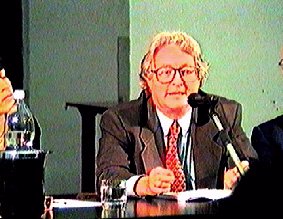 The City from Imaginary to Fiction
Wanting to give a title to these reflections, I believe that the following could be chosen: The city from imaginary to fiction. The city is romantic. By this I mean simply that it has provided the settings for the greatest novels of the 19th and 20th centuries. It's a fairly obvious observation, but one that might cause us to reflect if we apply it to two intersecting points of view. We imagine the writers through the cities that they have evoked, the cities that these people have loved and described. Marcel Proust and Thomas Mann are a part of Venice. Many Italian cities will always retain a Stendhalian appearance for the visitor. Likewise, pronouncing the names of these authors often evokes the cities for which they knew how to gather the sounds, colours, perspectives, and the alchemy that in the eyes of the visitor sometimes modifies and transfigures places into states of mind, and states of mind into landscapes. This ability to transmute is what makes cities poetic, therefore one can obviously cite them next to (or instead of) the names of novelists or poets. If the novel more directly attracts the attention of the anthropologist or ethnologist, it's because there they discover the trace of an enigma that fascinates them and for which the city offers an exemplary setting. This enigma demonstrates both an inconceivable loneliness and the impossibility of society. It is the evidence of a threat that will never be fully realized_loneliness_and of an ideal that will never be really accomplished_society. This poetic and romantic dimension is often marvellously expressed in cinema. The films that we watch as spectators connect the gaze of the camera (of the director) to the itineraries of the characters who are found or lost in the city. I am thinking particularly of the shadowy scenes in American films from the 1940s (in which everything we watch is memory, at least in black and white). The city exists through the imaginary that springs from it and returns to it, the imaginary that it feeds and from which it is nurtured, to which it gives birth and which gives it a new existence. The evolution of this imaginary is interesting because it concerns both the city (with its constants and changes) and our relationship to the image, which is itself modified as it modifies the city or society. Interrogating the imaginary city means posing a double question: the first concerns the existence of the city and the second the existence of the imaginary in a period characterized by the expansion of urban fabric and the diffusion of images in every part of the world. Thus, this means to interrogate the actual conditions of daily life. We could imagine the city in which we live, and make it support our dreams and expectations. In order to try and answer the first question I will compare forms of the city to forms of individual and collective imagination, evoking three aspects of the city in succession. I want to speak first of the memory-city, that city in which traces of the large collective history are inserted, but also million of individual histories. Then I will discuss the encounter-city, that is the city in which men and women can meet, but also the city that meets them, that reveals itself, that we learn to know almost as if it were a person. Finally, I will try to evoke the fiction-city, the city that threatens to annul the other two, the planetary city similar to other planetary cities. This city, made of images and screens in which the gaze risks going mad, as in a play of mirrors that recalls (I say this for the cinema lovers) the final episode of Woman from Shanghai. First of all, memory and history unite in the city; each inhabitant of the city establishes a particular relationship to the monuments offering testimony to the deeper collective history. Naturally, these references to history are not always exactly decipherable on the part of all those people crossing the city, but they are in any case present along every route. This bond is more evident, for instance, when the paths of whoever lives or works in the city cross the paths of those people visiting it; this reminds the former that the environment in which they live could become for others an object of curiosity and admiration. From this point of view the subway is exemplary, even doubly exemplary. Each day a great many people take the same subway, they change lines at the same terminals, they get off at the same stations. These daily trajectories create a kind of familiarity between people who have the same schedules, and an even larger familiarity between the passengers and the names of stations (by now memorized like a nursery rhyme!). These names are often connected to those of the city's surface which, most of the time, constitute a direct or indirect reference to historical facts. The metro in Berlin had a singular poetic aura, of course, because two Berlins existed and because it travelled to a mysterious border that separated two worlds, but also because names of certain inaccessible stations (Franzoesische strasse) alluded to the surface geography and to a removed history. A sort of metropolitan "no man's land" between the two Germanys. The subway is doubly exemplary because it is also a place of personal memories. A person who today uses a certain metro line probably followed other routes in the past, transferring at other terminals, because he or she had a different professional, family, or love life. In the oldest subway lines the larger history and minute histories mix their voices and their names, creating a type of intermediary and fixed memory. The memory of the subway is enriched by memories of events that are a part of collective memory, but that some individuals might remember having personally lived, such as the fall of the Berlin wall or the Liberation of Paris. The historical depth of the city is often united with the ideal of modernity: this is very important, since such ideals today are likely difficult not only to attain but also to retain. Modernity accumulates and reconciles. I have already quoted Baudelaire's poem "Tableaux Parisiens" in which the poet, gazing out his window, notes the confusion of the urban landscape, with its church belltowers and factory chimneys. Starobinski, commenting on this poem, insisted that the coexistence of these two elements is precisely what determines modernity. But at the same time, this poet's observation is the observation of an individual who does not identify with either of these two moments. The ideal of modernity is revealed in all activities that understand the mix of genres that recompose the city. I think, for instance, of any of the "great works" ("grands travaux," a typically French expression) realized in Paris during the two seven year terms of Fran‡ois Mitterand, like the Pyramide at the Louvre. These works also have another meaning, however, since they contribute to the building of new districts, like the Grande Arche de la D‚fense. They can also contribute to the physical remodelling of another area, as we see with the large MinistŠre des Finances that was built by Chemetov in Paris's Bercy quarter. In these cases we contribute to the formation of something that is now above and beyond the ideal modernity, to an application of double movement that characterizes contemporeinity and that unites a form of local segregation within the city with an ideal of global communication. Memory is probably fading; the conditions of memory change, since the memory-city is also subjected to history and particularly to the future history that will define the meaning of new buildings. Benjamin, as we know, anticipated the architecture of the 20th century in his analysis of Paris's covered galleries of the 19th century. But the memory-city is even more dependent on spent history, the history that, in its good and evil, evokes and reproposes conflicting memories. I can think of Emmanuel Terray who wrote a book entitled "Ombres Berlinoises" ("Berlin Shadows"), in which he inventories the diverse types of historical markings one can trace in certain places or on certain monuments in Berlin. Here we find already almost forgotten and obsolete testimonies, like the Soviet memorial to Trepetoff. Then, certainly, there are the cemeteries with graves of illustrious men and certain buildings that are present almost like sections of geological excavations, historical sedimentation of events in quick succession: the Weimer Republic, Nazism, Communism, and post-'89. From memory to encounter is a brief step, since historical references and monuments present themselves to the memory with an individual countenance. Contributing to this is also the material and sensual existence of the city. The city is landscape, sky, shadow and light, movement. It is odour: an odour that changes according to seasons, situations, places and activities. This sensorial dimension plays an undeniable role in the phenomena of memory. We find ourselves in a city for the pleasure or the sorrow that we had left there. For instance, it could be the stale and mixed odour of disinfectant in the subway passages, or the odour of coal hovering in every city in Eastern Europe, or a particular light such as in Brussels, where sometimes the sky is so blue and leaden it makes Magritte seem a realist painter. Thus, to encounter a city very often means discovering a multiplicity of sensorial devices. Novels and cinema have used this theme in their own ways, creating through images a certain aesthetic operation that extends to moral or social considerations. The theme of the peasant who discovers the city, of the provincial who "climbs" to the capital city (this is the expression used in France) to discover a different world from what he knew, a shaken and feverish world that includes work, festivities, and sometimes also vice. Noise, movement, and lights are contrasted to silence, calm, and obscurity, or to the starry skies of the country. Think, for example, of the contrast that Murnau represented before the war in his film "Aurora". But it is a recurrent and frequent theme of late 19th century novels and remains true on every level. The shock of encountering urban life, the city, is not always characterized by a clash of ideologies or habits. It can also have the value of discovery, of invitation, of solicitation to reflect. In this case, we should say that the city is no longer contrasted to a different world, it is no longer a metaphor for social situations or moral convictions. It becomes metonymy instead, personification. Aspects of the city (its architectural configuration, its color, a building) gives that city a personality, an individual character, bound to strike the mind of the artist, painter, or writer. I'll use what might be an arbitrary example: Paul Val‚ry, in his story titled "M‚langes," evokes a number of European cities, particularly the French town of Montpellier. He chooses this place because he was deeply struck by the exceptional purity of the air. What he impresses upon us is an urban view, a picturesque one at that. I won't quote from the text (because it's impossible to translate), but he speaks about an alley between greystone houses that finally opens upon the view a mountain, an intensely blue mountain surrounded by pine trees. This for him is Montpellier. He remembers what the geographer Augustin Berque wrote about Tokyo, that Tokyo was once disposed in a such way that one could literally see the sea or Mount Fuji from practically every street. Then the insertion of tall buildings into the urban area twisted this arrangement inside ampler space. We could go through the testimonies of writers (who are already quoting others) that are momentary emotions, personifications of the city, identifications that seduce the author. I will cite another example, that of the painter Fernand L‚ger, who in his correspondence often refers to the cities in which he's staying. We have postcards and letters in which he speaks about Marseilles, Chicago, New York, and Anvers. The city, its personality, where a personality even more vast is expressed_the country to which it belongs_are all elements mediated by the image. When he went to New York Fernand L‚ger discovered the verticality of skyscrapers and was "petrified" by it. I don't want to quote from his letters at length, except this phrase: "The elegance of certain skyscrapers is immediately stupendous!" ("L'‚l‚gance de certains gratte-ciels d'un seul jet, c'est stup‚fiant!"). Then of course, he comments upon the inhabitants of the place, which also conform to the image of the city. He speaks about Americans in these terms: "Splendidly barbaric, able to digest armed cement! " or "A precise people, elegant, pleasant. I like them a lot! " Another city Fernand L‚ger loved was Marseilles. He loved Marseilles as a cosmopolitan, messy, vivaciously coloured city. In a letter from 1934 he describes Marseilles, finding it always magnificent and always "awry"; then he adds: "I think I am much like Marseilles!". Around a year later, he wrote of one of his works (the decorations for a gym that were exposed in Brussels, but were also reproduced on a postcard): "It's beautiful and popular like a street in Marseilles. It has the air of the C“te d'Azur. It pleases me: it's vulgarity is perfectly realized! " In this way, personification is really complete: the city evokes the man, the man creates a work, and the work resembles a the city. What I want to underline here, through the solicitation of senses and emotions, is that these come to symbolize the multiplicity of the inhabitants. In other words, the city can have an imaginary existence only if it has doubly symbolic existence. It symbolizes those who live or work in the city, the whole community, made up of people who have occasion meet and speak with each other, who share a symbolic existence in the primary sense of the term: they complete the reciprocity and their relationships have meaning. This social significance is the minimum necessary condition because the imaginary procedure can develop from metaphoric forms and metonymy, from those forms that we find in art, novels, and poetry. It is also thanks to this meaning that everybody can appreciate the songs and refrains that speak about a certain city; when there is a deep bond and when these songs become "rooted" in the city, they become an inseparable part of its imaginary component. I want to stress that it's not idle wonder to ask why some cities are always present in the texts of songs and others are not, or why some aren't today that always were in the past. The theme of the encounter with the city is therefore tightly bound to that of the encounter in the city. The encounter in the city can be considered from three different points of view, which I will briefly discuss. The first point is that evoked by Michel De Cereau, who in his book "L'invention du quotidian" ("The invention of the daily paper") discusses the need to know how to descend from the World Trade Center, which means that one needs to be able to forget about the city map that corresponds to the constraints of a network of roads, to find instead the pedestrian's liberty at ground level. He says that in cities where walking is still possible, composing one's own walk is like writing a book. The second point is that of surrealism and romantic expectation. I think about Andr‚ Breton and the figure that appears one day on Boulevard de Magenta: Nadja. She is a figure that couldn't help but appear, since Breton walked the same path each day, observing everybody attentively. But certainly to provoke this encounter requires a certain type of city life and society. The third point is that of fluctuating attention, as the psychoanalysts say. Breton's fluctuating attention that sends him walking out on the streets is possible only in a context animated by the flow of work and free time. This attention requires the presence of an order imposed by a dynamic society. It's as if this constraint enriches the imaginary. The city is the fixed point of this imaginary, while the imaginary reflects the form of the functional city and the general order to which encounters are subjected in the city. But what does this have to do with the fiction-city? Here I propose a brief detour that will allow an examination of the phenomenon that we might define as the "mise en fiction du monde" (roughly: the world's surrender to fiction). The world is being more and more organized to be viewed, photographed, filmed, and at the end projected onto a screen. The city's most prestigious locales and most famous monuments are illuminated every night for visitors. But gradually we are coming to expect this spectacle proposed to us: that of images. We could make an example concerning tourism: whoever goes to visit Mont Saint-Michel will be fatigued by their walk up to the top of the hill, because along the road they will meet innumerable vendors of photographic and cinematographic material. You could say they are showing off a better Mont Saint-Michel than the one visited in person. But, since the visitors want to make images in any case_to develop in their darkrooms or project with their projectors_they put their flashes to work regardless: they film a film. Certain travel agents have already told their customers what are the more interesting places to visit, which if you want are reproduced in three-dimensional form on the Internet. This touristic hors-d'oevre is not really more virtual than the tourism centered on the "future past," those people who look at everything from behind the camera lens. The ambition to "mise en fiction du monde" grows stronger and stronger. New universes are born in the open country: the amusement park. Disneyland constitutes its archetype, with its pretend streets, a false American city, a false saloon, a false Mississippi, a forged castle of Sleeping Beauty. Disney characters runs between these fictitious places and together compose a fictional setting of the third degree. The fictions of European fairytales have actually already been transposed to the screen and currently return to reality at the visitors' disposal. Images, images, images... how do the visitors behave? Naturally, the first thing they do is make photos and videos, bringing all those characters, who never even wanted to exit in the first place, back into their little black boxes, but at the same time adding their relatives and friends to the fiction. Wife and children, grandfathers and grandmothers will all soon be able to meet on the television screen, together with Mickey Mouse, Donald Duck and Prince Charming. The quantity of diversions, vacation clubs, amusement parks, and theme hotels, but also the private cities that have risen in America or the protected residential zones that are being built in the cities of the third world, without connections to the rest of the city, form that which I would define as "bubbles of immanence." Other bubbles of immanence are constituted, for example, by big hotel chains or shopping malls that reproduce the same interiors, play the same music, and sell the same products in every corner of the world. Bubbles of immanence are the equivalent fictions of cosmologies. They are closed worlds, different from the great modern cities. They are characterized by a series of artistic, architectural, musical, and textual references. These references that allow us to always recognize a place are more concrete and comprehensible references than any used in ancient cosmologies. In fact, cosmologies are visions of the world. Bubbles of immanence exclude symbology, a way of relating with others. Symbology is replaced by a code of good consumer relations. Bubbles of immanence are the parentheses that can open and close at their own discretion, according to their own economic motives. Beyond these examples we should note that the circuit, the repetition, the echo, are today the dominant figures, applicable to extremely varying dimensions. Satellites circle around the earth, they observe it, they photograph it. Fixed satellites are used to capture images transmitted from the opposite side of the globe. A net of commercial intercourse entwines the earth, furnishings recall other furnishings, one advertisement recalls another advertisement, the couple celebrates the couple. Thus the fiction is spurred on : it's no longer confined to the creation of parentheses, but confronts reality directly with the intention to transform it. It is an easy enterprise until it tries to create a certain musical atmosphere in the supermarkets or in the corridors of Barcelona's metro. I have been in Barcelona's metro and I can tell you that there the impression strikes you that you are walking around inside a kind of movie screen, accompanied by pleasant music, as if in the closing scenes of a colour film. The enterprise becomes much more ambitious when it tries to impose its own criteria in city form. A few months ago the newspapers reported that an architect's studio (I believe it's called Architectonica), as executor, and the Disney Corporation, as promoter, had won a competition sponsored by the City Council and State of New York. This competition concerned different projects: the realization of a hotel, mall, and recreation center in Times Square, as well as the restoration of a one hundred year-old hotel, the "New Amsterdam", on Manhattan's 42nd Street. Disney Corporation, it seems, is also supposed to develop an entertainment program for Central Park and open a large store at 711 Fifth Avenue, where they will sell all the by-products of their films. The plan is striking for its spectacularity: the new hotel will have 47 floors and 680 rooms. The building will be delimited by a channel crossed by a galactic ray. The Disney Vacation Club, which presents itself instead like an immense container composed of one hundred apartments, will be covered by ten giant television screens (one for each floor) and by numerous lighting panels. The most remarkable thing about this project is the plan to put the world of Superman into the center of the city_like a normal urban component_, a world that was conceived at the beginning precisely with the intent to create an imitation of the city. The architects have chosen an "aesthetics of chaos", but it is chaos drawn from the comic strip, from animations. The plan being realized in Times Square is faithful to the aesthetics of amusement centers that already exist. This aesthetics remains extraneous to any debate concerning the work's meaning; which means that the "Disney effect" takes itself seriously, it is its own reference, and has constituted itself as a self-referent for the future. Fiction imitates fiction. The Disney example (which is nothing more than the most extreme enterprise to "mise en fiction" that I allude to, the process of "spectacularization" characterizing our epoch) gives us an idea of what a world of pure pretence would be like. But perhaps we're already living partly in a world of this type. And perhaps we can also think of the "non-places" that I have evoked on other occasions as being measured above all precisely from their capacity to be fiction. An airport or a large hotel is not ever very distant from Disneyland; on the other hand it is rare not to encounter any traces of fiction in shop vetrines or on posters in Asia, America, or Europe. Mickey Mouse's ears are perked in order to listen to the whole world. All the examples that I have used are evidently the extreme limits, they express the tendencies and risks, and not the sociological totality of all the world's cities. However, they're worth keeping in mind for certain lessons they teach and to ask ourselves what might be useful ways to avoid the fiction-city that destroys the memory-city and the encounter-city. It seems fair to conclude that urbanists, architects, artists, and poets should acquire an awareness of the fact that their destinies are connected, because their primary material is identical. Without the imaginary the city would no longer exist, and without the city the imaginary would disappear. But the bond that the imaginary and its long-term affects build with space is a complex bond. In the Parisian outskirts many big buildings have been destroyed in the name of architectural beauty; their explosions were transmitted live on television. It was possible to see on these occasions many of the older inhabitants crying. So we saw on live TV that the aesthetic happiness of human beings is not a simple thing at all. My second observation concerns a problem now particular important in France (but I believe also in Europe and other countries of the world): the problem of urban outskirts and of urban fabric beyond the city center. Concentrated here in these peripheries are the "non-places" of consumerism, traffic, malls, airports, freeways, garbage dumps, aggressive advertising, service stations, etc... Unemployment is greater in these zones, as are the concentrations of immigrant populations. These outskirts are sometimes considered models of anti-urbanism, in all the various meanings of the term. A border separates these degraded spaces from the fiction-city, which we show in specta-colour to visitors coming to stay from other places. In Paris, it seems to me, one symbol of the fiction-city is the Forum des Halles. Built entirely underground, this is the place that sells everything and where the regional subway (R.E.R.) brings the inhabitants of the outskirts who come to consume the image of the city. Certainly, these "banlieux", these outskirts need social economic, civic, and political attention. I would also say that we need to recreate the conditions of the imaginary as well, since this is always revealed everywhere a real sociality exists. We could also say: if the politics of all these places, the suburbs and the peripheries, are made good, we will begin to sing again. There was a time when to know we were a bit Parisian we would sing "Nogent, Chaville, Joinville le Pont." Some of these populations (young immigrants, young North Africans) are beginning to create their own forms of art, but it is almost always in polemic with the city. But in any case, the existence of artistic forms such as rap, etc., is to me a positive sign. I want to finish with a final encouraging observation: in some films that I have found very stimulating, the directors have tried to revalue the shapeless spaces of the city. I think about Nani Moretti's "Caro Diario", where the protagonist moves among the suburbs of Rome, or Wim Wenders "Lisbon Story", where he explores a world of neglected appearances. One could say here that the images precede the function, they point out the places to construct or re-invent, they define a space for encounters. They spend time in abandoned grounds, marginal zones, provisional deserts. The movie camera with its coming and going, like a hunting dog who's smelled the prey, says that this Rome is also part of Rome, that this Lisbon is also Lisbon, and that we must not lose track of the escaping imaginary. Since the imaginary is always a positive signal, I believe we don't need to occupy ourselves with science fiction, those fictitious images with no symbolic armour. Our intent instead must be that of re-symbolizing the real and resuscitating, if possible, the imaginary and life. |
||

|  |