|
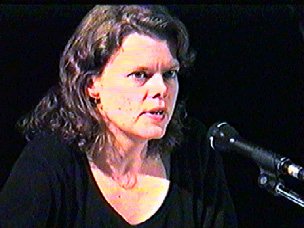 Today I'm going to give you some background on Group Material and show slides of Group Material projects in public places as well as other relevant artists' and groups' work. That will be followed by account and evidence of some recent developments in the Times Square area of New York and public art projects which precipitated these developments.
Group Material is an artists' collaborative founded as a constructive response to what we found to be the unsatisfactory ways that art was being taught, exhibited, and distributed in American culture at that time. When we started in 1979 there were thirteen of us but within a year and a half there were only three (Mundy McLaughlin, Tim Rollins and myself). Group Material has had a changing membership over the years but for the majority of its history there was a group of four working within a non-hierarchical organizational base.
There were various conditions and shared purposes that led to the formation of the group. A lot of us had just come from art school, where we were trained to develop a 'unique' artistic voice. We were also trained to believe that after school you then can go exercise this voice in the so-called real world. This seemed to be pretty much of a false promise considering the limitations and biases which accompanied market principles and the commercial art system, and, many of us were not interested in making objects, but in collaborative processes.
We were collectively intent on combining our social and political motivations with artistic practices, which is more common now than it was at that time.
Then, the lines between art and politics were more clearly drawn and that delineation was commonly supported, often with the stated interest of preventing the contamination of art with politics.
Our inaugural poster stated some concerns:
"We want to maintain control over our work, directing our energies to the demands of social conditions, as opposed to than those of the art market. While most art institutions separate art from the world, neutralizing any abrasive forms and content, Group Material accentuates the cutting-edge of art. Our project is clear: we invite everyone to question the entire culture we have taken for granted."
Group Material's primary medium has been the temporary exhibition. For our first year we presented exhibitions in a storefront which we rented and operated. After that we started producing exhibitions in interior spaces, at various kinds of art institutions, and we've also situated exhibition(s) in unexpected places, or public space. By public space for the most part I mean advertising space, which of course is private but in public.
So Group Material has rented space in billboards and newspapers, in subways and train stations, etc., in order to bring the idea of an exhibition, and to bring other agendas than commercial into the public sphere. Those are the projects I'm going to focus on today, the ones where we've dealt with public address, and social agendas within the environment of commerce and advertising.
Rather than isolate our practice artificially I'm going to situate Group Material's work within the larger context of certain social conditions in New York from the early 80s on, and in proximity to a couple examples of other artists' work in order to provide the sense that we operated with at the time, of working within a network of critical and oppositional practices, within various communities.
At the beginning of the 80s, and in the late 70s, the context for working as artists in New York was polarized.
There was a resurgence in neo-expressionist painting going on, with a notion of an heroic artist figure in the foreground. And on the other hand, there was an environment of feminism, anti-colonialist critique, civil rights, punk and do-it-yourself music culture, etc. There was a strong feeling of entitlement in young people and amongst artists and cultural workers_entitlement, to question authority, and desire and responsibility to have a voice in culture that was challenging, contestational, and collaborative among other things.
I'm going to start showing the slides, and pose a couple of questions in relation to this lecture series about urban space: What is possible, encouraged and allowed in public? What are the mechanisms by which public space is controlled? How do various agencies function and how are they utilized in order to get a certain agenda or message across in public?
How are artists controlled, censored, encouraged, and instrumentalized within various urban cultural contexts? What roles do artists take on "in public"? And, a reminder that the public sphere in conjunction with the political climate has changed dramatically since the early 80s to the 90s in New York, as we'll see in the example of Times Square.
A preface for the slides: from Sharon Zukin, author of an invaluable analytical book called The Culture of Cities :
"Building a city depends on how people combine the traditional economic factors of land, labour and capital, but it also depends on how they manipulate symbolic languages of exclusion and entitlement. The look and feel of cities reflect decisions about what and who should be visible and what should not, on concepts of order and disorder, and uses of aesthetic power. In this primal sense, the city has always had a symbolic economy."
I read this because these slides demonstrate dealing with a kind of surface or projection site within an urban context. This symbolic and real economy is a battleground between various ideologies, not methods.
At the beginning of 1980, concurrent with the beginnings of Group Material, a group of artists organized an event called The Real Estate Show. This was an important landmark and example of artists banding together to make a critical statement about an economic, political, and representational crisis.
The organizing artists illegally seized a storefront space on Delancey Street in the Lower East Side in order to stage both a thematic art show around the subject of real estate and more importantly to stage an action and media event against the City (sometimes referred to as New York's worst landlord) as the party responsible for warehousing or keeping vacant buildings that could be otherwise used by people for living or working space. The city-owned site they chose to occupy, 123 Delancy Street, was slated for potential shopping plaza development. The flyer distributed announcing the event stated:
"This is a short term occupation of vacant city-managed commercial property...The intention of this action is the show that artists are willing and able to place themselves and their works squarely in a context which shows solidarity with oppressed people and a recognition that mercantile and institutional structures oppress and distort artists' lives and works, and a recognition that artists, living and working in depressed communities, are compradors in the whitening or gentrification of neighbourhoods. It is important to focus attention on the way artists get used as pawns by greedy white developers."
The show opened on January 1st and on January 3rd the City of New York closed it down, locked the gate. Joseph Beuys happened to be in town at that time and visited the space, thereby providing a photo opportunity to the daily newspapers, resulting in increased media attention. This helped transform the event and circumstances of the show's shut-down by the city into a platform for spokespeople of the project to articulate their purpose and critique. The organizers had meetings with city officials from the housing department in order to negotiate a solution.
The city offered another nearby space that would be permanent space or semi-permanent depending on the viability of what the group did. Reluctantly they accepted the alternate space at 156 Rivington Street that would become ABC No Rio, an ongoing alternative space which is still open though threatened with eviction. This example is significant as cultural activism by artists, but also in terms of the impact of the compromise made. By accepting the alternate space, media attention and public discourse around this event ended, and the visible model of squatting or taking over space leading to negotiation was closed down and erased.
Around the same time as The Real Estate Show Group Material rented a storefront space on East 13th Street. Keep in mind that this was still the Lower East Side, but the Lower East Side within a few years would also be known as the East Village, location for multiple bohemian fantasies and alternative art commerce district to Soho and 57th Street. When Group Material opened its space on East 13th Street the intention was for a room of our own, and to make a laboratory within which to organize and stage exhibitions and events with social themes.
We also wanted to develop a relationship with the people living in the neighborhood, an immediate audience, in addition to relationships with the 'art world'. We were balancing multiple audiences and constituencies. This exhibition pictured, called The People's Choice is an example of redressing the notion of public through an exhibition. Hanging on the walls are articles and objects we gathered from residents on the block after distributing a letter door-to-door which read in part:
"Dear friends and neighbours of 13th Street. Group Material is having an exhibition and you're invited. Group Material is the gallery that opened this October at 244 East 13th. We are a group of young people who have been organizing different kinds of events in our storefront. We've had parties, art shows, movies and art classes for the kids who are always rushing in and out.
The Peoples' Choice is the title of our next exhibition. We would like to show things that might not usually find their way into an art gallery. The things that you personally find beautiful, the objects that you keep for your own pleasure, the objects that have meaning for you your family and your friends. What could these be? They can be photographs, or your favorite posters. If you collect things, these objects would be good for this exhibition."
What was important to us at the time and significant in retrospect about this exhibition is that it posed a different view of what is culturally valuable than posited by museums and other institutions considered to be official culture, and the 'collection' The People's Choice was an answer to what is culturally valuable determined by people not thought of as cultural experts. The People's Choice was not an ethnographic exhibition.
At the end of this first year that we had the gallery space there were various factions and arguments that had developed in the group and we decreased from a group of thirteen to a group of three. Although we started with a lot of energy and enthusiasm, as we more clearly identified and refined our ideas and interests, in terms of what we wanted to do individually and as a group, the original configuration basically fell apart.
One reason we then identified was we had fallen into the trap in setting up an alternative space. We were feeding into the commercial system and accepting the role of being overdetermined by our alternative status. We were waiting for people to come and see what we were doing rather than taking ideas and production to the streets and other places, rather than taking our own question to heart, "who is culture for and where should it be seen". With the demise of the initial group incarnation and on the occasion of giving up our storefront space, we issued a flyer titled Caution: Alternative Space:
"For the second season Group Material is a very different organization with new associates and new tactics. We've learned that the notion of alternative space is not only politically phony and aesthetically naive, it can also be diabolical. It is impossible to create a radical and innovative art if this work is anchored in one special gallery location.
Art can have the most political content and right-on form but the stuff just hangs there silent unless its means of distribution makes political sense as well. If a more inclusive and democratic vision of art is our project then we cannot possibly rely on winning validation from bright white rooms and full-color repros in the art world glossies. To tap and promote the lived aesthetic of a largely non-art public, this is our goal, our contradiction, our energy."
So it was quite liberating at that point to not have the obligation of a space ,and to define ourselves as an independent group that could function in different ways and spaces throughout the city. This opened the possibility to work site-specifically and in contexts of various institutions and bureaucratic agencies.
One of the first projects that we did in a public space or outdoor space was called Da zi baos, or The Democracy Wall. "Dazi bao" is Chinese for "large-scale character posters". Our cursory understanding of the democracy wall movement in China is that it is a traditional form of social written dialogue occurring in public squares. The chain of events is that someone or some group would mount a commentary poster about public policy or a certain issue on an outdoor wall. And then another person would come and put another poster next to that and so on and so on.
What ensued was a kind of opinion landscape, which in fact sometimes influenced public policy. In 1976 after Mao's death, Deng was reinstated in the party and by 1980 he consolidated his power and deleted four freedoms from the 1978 Constitution; speaking out freely; airing views fully; holding debates; and writing big character posters_the traditional form of political protest. We tailored the concept and form of Da Zi Baos and made a kind of constructed version.
We were thinking at that time, in 1982, about ways in which public opinion is instrumentalized and wielded by the media in the United States and how opinions and views are reduced to a yes or no, with no complexity or gray area in between, replicating cycles of reductive thinking. The process of gathering the statements that you see on the wall involved interviewing people on the street at the actual Union Square location where the posters were later installed about a number of social issues that were relevant to the site of Union Square and current events.
We juxtaposed those statement from individuals (black on yellow) with organizational statements from various groups (black on red ) who were working with the same issues. So in a sense the democracy wall is not so dissimilar from some of our interior shows in terms of the overall framework being a forum or a model of a democratic form. The first statement in the wall was from Group Material:
"Even though it's easy and fun, we're sick of being the audience. We want to do something, we want to create our culture instead of just buying it."
Juxtaposed with that was a statement by a housewife:
"Government funding of the arts should depend on the actual purpose, what they are giving it for. If it was being based on as far as to help other people or something like that I could see it."
Two other statements were about unions. An office worker said:
"Unions benefit society, but not in my office."
And the Home Health Care Workers Union wrote:
"These are rough times to stand alone. Even though people are now paid for working, the attitude of masters towards servants remains the same."
I want to point our that this was a very inexpensive project to do ($200) as we did them by hand. We put the posters up illegally at night, and they stayed up for approximately five weeks before they were covered up and/or dilapidated. Up until then Group Material had been self-generating financially, meaning the members of the group pooled our moneys to make events and pay for projects. Around this time we began to get National Endowment for the Arts (NEA) support.
These next slides are of a project by artist John Fekner who was working concurrently. The series of site-specific stencils in public spaces was called Queensites.
Talking about the purpose of this practice he said the works were intended to:
"Indicate the areas in communities that have a need for construction, deconstruction, or reconstruction.
Point out problems of the physical landscape pertaining to any of the structures or atmospheres in that area by labeling them as damaged or dangerous commodities.
Get sanitation crews to take faster action at clearing away debris."
And in an interview with Peter Fend in 1980:
"My signs point directly to the environment in one's life and the call for a greater recognition of ones actual experience. Advertising billboards call for a recognition of what's at the store or at the end of an airplane ride. I oppose the idea in advertising of selling a product or a place without regard to the immediate physical circumstances affecting one's body, such as pollutants or poverty."
This image is where Fekner had stenciled the word "Decay" on the side of a building in the South Bronx. Ronald Reagan was out there campaigning for the Presidency in 1980. The site was used as a backdrop by Reagan for a news conference_he appropriated the work for political purposes which in the end backfired because he made a lot of declarations and promises to the people of the South Bronx that he would clean up the area etc., and he was booed out.
But this is an interesting example I think of some overlaps within visual/media culture. An example of a sign, an art work in public being appropriated by those it critiques. This one: "The Remains of Industry" is an example of how he would go out at night and stencil on something that should have been destroyed but wasn't, and then it would be attended to quicker because it had been marked in that way.
This is another project by Group Material called Subculture done in 1983. We rented advertising space on the subway trains. In this case Group Material acted as a contractor because we made a contract with the subway authorities for the space and then we invited 103 artists to make thirty pieces each to put up in those spaces. The transit authorities had told us we couldn't do anything with political content or religious overtones and that foreclosed about ninety percent of what we wanted to do because we knew that most of the artists wanted to do something with a political or social message.
But given that this was the early 80s and it was before the culture wars, artists were not yet seen as symbolically dangerous, so there was really no oversight on what was installed ultimately because even though they warned us, we took the posters to the people who were putting them up. They liked the work so there were really no problems. The conditions for artists working in a public sphere where they have to negotiate with bureaucratic agencies is much tougher in terms of content being scrutinized.
There is much more restrictive control over what the content can be, and some artists have even gone to the Supreme Court to battle their right to free speech in this manner. This is one of the most successful pieces in Subculture. It was made by a woman named Vanalynne Green who was working as a performance artist and also as a secretary on Wall Street at the time.
She took a photograph of coffee cups and overlaid a story in one of the centers of the cups about how each morning her boss asked her to bring him a cup of coffee and she would smile as she handed it to him, remembering and relishing that she'd poured it in a dirty cup. For the month of September that year that was one work on every subway car on the IRT train.
This project is an interior exhibition by Group Material included here because we were thinking critically for this about what is American culture, what is this monolithic notion of the American public that is commonly promoted? It was called Americana, done in the Whitney Museum in the biennial exhibition in 1985, and it was the first time that Group Material had been invited by a so-called dominant institution or museum to do an exhibition.
Traditionally the Whitney Museum Biennial is a survey of what the curators deem important or significant in American art in the last two years. I'm going to frame it cynically, but our view of the Biennial was that it was a very narrow vision that informed selection processes, making a kind of greatest hits of what had been going on the galleries and what had been selling the best, and didn't necessarily have much connection with what was happening on a larger scale in society.
So given that the parameters or the frame for the exhibition was the Biennial, we thought we would make a model of our own biennial or what we though was important but left out of the Whitney Museum, and that included not only some artists but also elements of mass culture or so-called low culture.
We were also trying to make a link between aesthetic choices people make shopping for instance in choosing a washing machine or which kind of cereal to buy, and the choices, in some ways based on taste, the Whitney curators make when shopping on a grander scale, for the museum collection. Americana also addressed the idea of the Whitney as a national museum, it's actually called the Whitney Museum of American Art, and thereby is defining their idea of American art is, and we wanted to take issue with the exclusivity and white-washed picture of American art is and open it up so it was more inclusive of women artists and artists of colour as well as excluded political agendas.
The idea was to make a less elitist version of American culture and temporarily symbolically remove some borders of high and low culture, ultimately to question what is valued.
This project from 1988 was called Inserts. Again we were acting as a kind of contractor by renting this space and then turning to artists to supply the content. In this case the advertising space was in a newspaper_the insert went into 90,000 copies of the Sunday New York Times which in theory reaches about 150,000 readers.
We invited 10 artists to make one page each, this first one on the left is by Mike Glier and the one on the right Jenny Holzer. Here Barbara Kruger and Carrie Mae Weems. Felix Gonzalez-Torres who had just prior become part of Group Material, and Nancy Spero on the right. Nancy Linn and Hans Haacke. Richard Prince and Louise Lawler. We had originally planned Inserts for the Daily News which is a more local less intellectual paper than the New York Times.
We had been negotiating with the Daily News for about a year but never actually signed a contract. And then when we finally went to them with the mock-ups of artwork we wanted to produce they rejected it on the basis that "it wasn't art it was editorial". So then we took the project to the New York Times and worked with the "advertising acceptability director" there, who was concerned that the piece by Carrie Mae Weems' work would be misunderstood by members of the audience as racist and wouldn't know it was made by an African-American artist, but eventually they accepted the project.
When Group Material has done projects like Americana at the Whitney or even with Inserts there is often a zone of compromise. From our point of view it's been worthwhile to negotiate at times. We certainly aren't interested in diffusing the content or meaning of our work, but we are interested in working at least temporarily with and within these institutions and not marginalizing ourselves. So for instance with the Whitney, in a sense they are using us in order to fulfill a certain function, to take care of certain social issues, and in turn we use it as a platform to pose a different set of social agendas.
This is a project Group Material organized with several organizations. We worked with Randolph Street Gallery which is an alternative space in Chicago and then with six community organizations spread throughout the city. So there are different levels of collaboration going on in this project. Group Material is itself collaborative, which is non-hierarchical and we don't use the corporate model which is along lines of expertise but we work together and take responsibility as a group for every aspect of the work. And then there's a collaboration or dialogue with the those artists and non-artists we work with, in terms of participation in the various projects.
And in the case of this project which is called Your Message Here we were collaborating from the beginning on the project with seven other institutions or organizations in terms of conceptualizing, putting the call out to artists and non-artists to place Your Message Here, selecting the material, and then actually realizing the billboards. Especially in low income neighborhoods in Chicago there is a predominance of cigarette and tobacco advertising on billboards.
The idea was to replace some of that advertising with other messages, other images and agendas for a three month period. We had forty billboards donated by Gannett Outdoor Advertising on which we could display whatever we wanted to.
We put out a call through the six community organizations for people to propose what they wanted to see on billboards in their neighborhoods. It wasn't exactly a competition but we made a selection from about 140 proposals that we received to about forty that became actual billboards. We ended up with a very wide range of artistic approaches to the topical, vital social problems that people were thinking about in the neighborhoods of Chicago.
Another level of collaboration that took place in this project was that there were a number of people who were not artists so they would be positioned with graphic artists or artists to realize their projects. This one was sited across from a high school, and it was done by Act-Up Chicago. They wanted to put it next to a high school and have the issues that are not talked about by students or in the general school policy such as sexuality etc. This piece says "no human is illegal". You can see there is a lot of variety in terms of the medium that people used to make these billboards as well.
This was done by a homeless organization, the Chicago/Gary Union of the Homeless:(We may not have homes, but we do have names, and we live here too). So with a project like this we were really starting out with the idea that to incorporate new images into visual representations of the city can effectively and symbolically pose cultural democracy. (The war on drugs is a war on people. The real enemy is hopelessness in a dead-end system, by Vito Greco).
This is a piece by Martina Lopez. She was asked what she would like to see on a billboard and she said she would like to see pictures of the people who lived there, friends and family, so she went and collected those and then worked with a graphic designer to make the final image.
There you see her billboard in situ or in context with the other ones for liquor. I love this piece and it also reminds me of The People's Choice project in a sense. At this point Group Material was composed of Doug Ashford (who joined in 1982), Felix Gonzalez-Torres (joined in 1987), Karen Ramspacher (since 1989), and myself.
In 1982 The Public Art Fund began a program called Messages to the Public on the specta-color light board in Times Square. I'm going to show a video of the various projects which happened there as well as read some excerpts about the ten year history of this program. The press release from the Public Art Fund describes the program:
"On January 5, 1982, the Public Art Fund announced the inception of its program Messages to the Public. Beginning of the 15th of January the giant computer animated spectacolor billboard on the old Allied Chemical building at 1 Times Square will broadcast a thirty second art message to the 1.5 million potential viewers in the Times Square area every day. Recent projects in the Times Square area, notably murals by Richard Haus and Alex Katz in collaborative projects Times Square show made clear how effective art is in enhancing and revitalizing troubled urban centers.
Messages to the Public is a classic example of one of the Public Art Fund's principle goals to marry an artist's individual expression to the public's expectations."
The picture on the right here is by Nancy Spero and that is actually a piece that was done for the spectacolor that was censored. Ellen Lubell described the politics of censorship in her article Spectacolor Short Circuits in the Village Voice 10 February 1987:
"Late last summer Nancy Spero's feminist messages were quashed after they'd already going into production, and at the end of November video artist Dara Birnbaum's piece was rejected before it could be shown in its agreed up on Christmas-New Year's slot. In both cases normal procedures had been followed and in bother cases spectacolor owner George Stonebelly stopped them cold."
The way that the economics of this situation work is that George Stonebelly owns the spectacolor board and gives a donation to the Public Art Fund in exchange for a tax break from the city for what he donates in terms of time and light-bulb use. Continuing with the Village Voice article:
"These are not the first incidence of rejection or demands for revision in the messages program. A piece about Ronald Reagan's politics by Hans Haacke never saw the lights on Broadway due to a reported that politically-oriented Haacke could produce something later on that would pass through. Haacke says he 'lost interest, because I knew that whatever I came up with, whatever that was of interest to me, was not likely to be acceptable."
The spectacolor board existed for artists use through Messages to the Public from 1982 to 1990. Similarly to Group Material projects and other projects I've shown you there is a very strong context for this kind of work in terms of Reagan being elected in 1980, the conditions of the Reagan and Bush administration years. A lot of us had a very clear sense of who the enemy was, which generated a lot of critique and protest oriented cultural activism. I'm going to leave the video going, it's about a thirty minute video but we can just let it run. In 1990 the year in which Stonebelly sold the board to another private company, you see in the photo the removal of the board.
The following is documentation of a related project in that it occurred in the Times Square area and was organized by Creative Time, an arts agency with similar goals and functions as the Public Art Fund. Creative Time is an agency that commissions art projects in unexpected places throughout the city. In 1993 Creative Time administered an art project in the storefront spaces on 42nd Street between 7th and 8th Avenues.
This block, perhaps one of the most famous and infamous blocks in New York City, was formerly inhabited by a network of commercial enterprises such as movie theaters, adult entertainment and sex industry establishments (pornography shops) and fast food places such as Kentucky Fried Chicken and Tad's Steakhouse. This "traditional" fare was emptied in 1993 by the state's right of eminent domain and for the summer of that year the storefronts were reanimated with projects by forty-five artists. A New York Newsday article by Amei Wallach stated:
"The artists have been invited in by the 42nd Street New York Urban Development Project because all else has failed, because artists have been known to rescue dead neighborhoods. From SoHo to the East Village they have been unintentional stalking horse for real estate interests before, and this time they are willing accomplices in a new effort to save Times Square as a retail entertainment center."
This is a piece by the design firm M & Co., whose chief designer Tibor Kalman collaborated on the draft proposal for the New Times Square. For this piece he graphically displayed the word "Everybody", employing it as a kind of emblem of democracy. And I say this cynically because the whole notion of a new Times Square, changing it's seedy sex industry status in order to make it more attractive and comfortable for tourists and legitimate consumers is framed by the city, developers and architects as democratization when of course it's more complex than that_contrary to what many Americans confusedly believe, democracy and capitalism are not synonymous.
There were a number or communities that were being served by a number of industries, but those people and communities are not legitimized in the eyes of the city. The redevelopment ushers in the "vulgar heterogeneity" desired by Robert A.M. Stern, the architect who drafted the redevelopment proposal in collaboration with Tibor Kalman, Mr. Everybody.
So in the case of this project on 42nd Street there were a lot of artists such as John Ahearn, Jenny Holzer, Lyle Harris, Glenn Ligon, etc._people whose agendas who are not conservative by any means_kind of feeding into a conservative agenda and aiding the "cleaning up" of Times Square. Reading from Culture of Cities again, Sharon Zukin wrote about this project:
"The on-site art installation drew so much favorable attention it was repeated the following year. The representation of Times Square as both a populist and avantguard cultural attraction helped by continued public subsidies for hotel construction and office relocation attracted corporate culture industries. The Disney corporation decided to open a theater for live stage shows on 42nd street and MTV, whose corporate offices are already in the area decided to open a new production studio."
So there's a direct relation here...in a sense artists were used in this situation to usher in the next step of cultural capital into that area. I suppose for Creative Time and a lot of the artists who participated it seemed to be an opportunity to show their work in a different space to a different, wider audience. Another aspect of the context for this unlikely partnership that developed, is that because of the culture wars many arts agencies, institutions, and artists in general have been so under fire for the last five, six,
seven years there's been a pressure to reach a larger public and for artists to kind of advocate for their legitimacy and viability in the culture. So it's almost like a way of saying "look, artists do have a social function and we can be a positive force in this situation." Creative Time was probably responding to a lot of the culture war attacks on art by taking on a project like this. And in their flyer for this whole project they even said:
"42nd can be a symbol of the decadence of our culture, but in its fierceness and danger can we also find hope? We can change the order of things, we can redevelop, and artists with great wisdom and passion can help us to do it."
So even though I think for individual artists like this piece like Lyle Ashton Harris or the previous one by Lady Pink, they were making a social critique within their work and seeing their participation as oppositional, but the framework from the beginning was tainted. That was 1993. In 1994 the whole project of Creative Time organizing artworks in the empty stores was repeated. You're probably aware to some extent through the media of what's happening there which is a concerted effort by the city, the Republican administration and the businesses in the area to clean up Times Square, so its going to be the new, safe, family-oriented, Disneyfied version of Times Square.
Obviously this is economically driven. This is the street sign, it has actually been changed from "W 42nd Street" to "New 42nd Street". This is the visitors' center where there is an exhibition showing what's going to happen in Times Square. When you go inside the center, itself a storefront on 42nd Street, on the left wall there is a kind of black and white (read: over) photo montage of the past glory of Times Square, that conveniently leaves out most of the sex industry. The focus is more on Broadway theaters and the legitimated commerce of Times Square.
On the right hand side, all the images are in color (read: coming). There is the Virgin megastore that opened recently, a new McDonalds, Madame Tussaud's Wax Museum, New City Theater, Times Square Store, John's Pizza, the Firebread restaurant... that gives you some idea of the concerns. This is what in actuality 42nd Street looks like now, the old movie theatres have been closed down they are in various states of being repaired and changed. This is the transition moment, some reality in between the adjacent walls of the New Times Square Visitor Center.
The Disney store opened about a month ago further east on 42nd. There are pockets of what's left of the sex industry economy which is being converted to a different kind of economy, corporate/consumer economy of office buildings, hotels, and thematic restaurants intended to cater to tourists and families. I realize this ends things with an air of pessimism but I think I was too ambitious, I have another tray of slides. It's 7:25 so perhaps its better to have some discussion and questions.
QUESTIONS
If the criticism of the 42nd Street project is founded on an analysis of what was there before, there is obviously some constructive critique of the changes in this zone, of its "Disneyfication". But is there not some nostalgia for what was there, the sex industry? Why was this more real in respect to the family-oriented culture being promoted now?
It's less nostalgia and more anger at the way that private initiative with the proper power base is able to totally demolish a community in the name of so-called public good and using the vocabulary of public morality for a private commercial agenda. Times Square has been changed without any thought or solutions for the people that operated commercially and inhabited it formerly, who have now been displaced.
The city of New York, the same one that doesn't have the funds to build adequate housing for low-income people or adequately house it's homeless population_found $35 million to acquire the last private buildings on 42nd Street ($180 million had been spent between 1990-93 to buy others). It's not a matter of whether I liked it how it was before and don't now, I can get touristic and voyeuristic pleasure from either, but it's the political process that's informed by economics and the selective privatization process I want to emphasize and not the result of getting rid of the sex industry in Times Square.
At this moment does Group Material have a work in process, or what have you done in the past two or three years?
Group Material isn't working on any specific project at present. I would say we've been in decreasing activity mode for a while. It's a mixture of cultural changes and changes internal to the group that inform the decrease of activity and recent period of stasis. Some of the slides I didn't show yet are from the piece called Program for the Three Rivers Project in Pittsburgh, for which we made a contribution to the brochure guide . That's the most recent project from last summer.
I want to understand a bit better the motives for a certain change within Group Material. Before you realized projects with others, "the people", directly, such as the storefront project, then you gradually became more distant from people... Was it only to enlarge the audience or was it a critical change?
The participant community on 13th Street is not more real than other constituencies just because it is composed of low-income people of color. It's important not to romanticize "the people" and "community" along lines of disenfranchisement and oppressed status. For every project there is a community that is location-bound. Later in our work, when we did not maintain a stable space, communities were not so easy to categorize or locate. After that first year we engaged communities of concern, revolving around a particular issue, such as around the AIDS crisis or Education.
Also, Group Material has always agreed on this_the art world with all its implications is also an important community for us too. That is where we choose to work and obviously it's not one-dimensional or monolithic. Even as we target other groups as audiences...
How do you gauge responses? The idea of dialogue is great but if you get no responses then they are just slogans...
I think in each project or situation it is very difficult to evaluate and gage effectivity or success. When we did Inserts in the New York Times we went out on that Sunday and it was pretty exhilarating to actually see the papers with our insert, and imagine how they might be received and interpreted. As exciting as it was to see them on Sunday, then on Monday we saw a lot of them in the trash, and realized of course, it's very unclear how and if they are used.
The best hope was that they were kept for a longer shelf life than the one day they appeared in print. In most of the projects that took place in and advertising space there is no real way to gauge it, particularly as the audience is somewhat random. In exhibitions it is different, you can get information from the guards etc., and we try to go hang out in the room a lot to hear what's going on.
AIDS Timeline of 1989 at Berkeley University was an attempt to chronologically account the development of the AIDS crisis, using variegated material gathered from fields of government and medical information, media representation of the crisis and community responses. And there were cultural artifacts that drew viewers further into history, sometimes by an emotional route.
We were committed to making an environment people would spend a long time in the exhibition, because it was a history being revealed, and it took about three hours to thoroughly go around the exhibition. We talked to the guards and the curators, who said it was effective because people spent time and came back. For exhibitions, if the guards, the people who are sitting there for most of they time day after day have good reports from visitors, and like it themselves, its a good sign.
|