
H a n s H a a c k e
Go back

|  | |
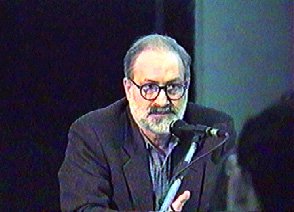 Buongiorno. I'm sorry that I can't speak to you in Italian. I read Italian to some degree, but, even though I have worked on exhibitions in Rome many years ago and more recently in Venice, I cannot speak it. This is my first visit to Milan.
After having worked for some thirty years, it is very difficult for me to make a selection of works to present here. I decided to speak about 10 works from the last 8 years. I chose them hoping that they might be of some interest and perhaps relevance to the situation here.
You know the term "site-specific." I like to stress that the site-specificity of many of my works is not restricted to architectural or other physical conditions in which I am invited to work and exhibit. At least as important for me is the social and political context. As a matter of fact, I would go so far as to say that, in addition to a traditional artist's use of materials like bronze, canvas, paint, etc., I also use the social and political context as my material.
I'd now like to give some examples. I'm starting with a picture postcard, a postcard such as you know from many cities showing the sites. In this case it is a postcard of the city of Graz in southern Austria (slide). I would like to draw your attention to the image in the center at the bottom. It shows one of the most prominent squares in center of the city. Relatively small, you see there, on top of the column behind the fountain, a statue of the Virgin Mary balancing on a crescent. It is a victory column. It was erected in Graz in the 18th century to celebrate the victory over the Turks
(the crescent represents the Turks). In 1988, as part of the annual Styrian Autumn arts and cultural festival, I was invited to Graz, along with 15 other artists. That year, the Austrians were commemorating the 50th anniversary of the country's annexation by Hitler. The curator of the visual arts section of the Styrian Autumn_they also present theater, film, music, etc._asked the invited artists to set up a temporary installation in public places where the Nazis had a major presence, for example the squares where Nazi rallies had been held, city hall, the building of the Gestapo headquarters, etc.
Like the other artists, I went to Graz to familiarize myself with the city's history. In the university library I looked at newspapers and publications from 1938. I found a booklet with the title "Graz: The City of the People's Rebellion." This was the honorary title Hitler conferred on the city, because Graz was the first major Nazi stronghold in Austria. In the booklet I found photographs like this (slide of Austrians lined up along the roadside giving the Hitler salute.) The majority of Austrians, at the time, did not consider themselves victims of an annexation, but celebrated their country being joined with Nazi Germany.
This photograph from the booklet shows you Herrengasse, the main shopping street of Graz, decked out with Nazi flags, leading up to the column with the Virgin Mary (slide).
And I also found this photograph in the booklet (slide). It struck me the most because it showed the column with the Virgin Mary buried under a red obelisk emblazoned with the Nazi insignia. It was erected to celebrate the victory of the Nazis on the anniversary of a failed putsch in Vienna in 1934. I thought that, in order to bring back some of the enormity of what happened in Graz 50 years ago, one should reconstruct the obelisk. When I made my proposal, I assumed it would be the end of my involvement in Graz.
Buongiorno. I'm sorry that I can't speak to you in Italian. I read Italian to some degree, but, even though I have worked on exhibitions in Rome many years ago and more recently in Venice, I cannot speak it. This is my first visit to Milan.
After having worked for some thirty years, it is very difficult for me to make a selection of works to present here. I decided to speak about 10 works from the last 8 years. I chose them hoping that they might be of some interest and perhaps relevance to the situation here.
You know the term "site-specific." I like to stress that the site-specificity of many of my works is not restricted to architectural or other physical conditions in which I am invited to work and exhibit. At least as important for me is the social and political context. As a matter of fact, I would go so far as to say that, in addition to a traditional artist's use of materials like bronze, canvas, paint, etc., I also use the social and political context as my material.
I'd now like to give some examples. I'm starting with a picture postcard, a postcard such as you know from many cities showing the sites. In this case it is a postcard of the city of Graz in southern Austria (slide). I would like to draw your attention to the image in the center at the bottom. It shows one of the most prominent squares in center of the city. Relatively small, you see there, on top of the column behind the fountain, a statue of the Virgin Mary balancing on a crescent. It is a victory column. It was erected in Graz in the 18th century to celebrate the victory over the Turks
(the crescent represents the Turks). In 1988, as part of the annual Styrian Autumn arts and cultural festival, I was invited to Graz, along with 15 other artists. That year, the Austrians were commemorating the 50th anniversary of the country's annexation by Hitler. The curator of the visual arts section of the Styrian Autumn_they also present theater, film, music, etc._asked the invited artists to set up a temporary installation in public places where the Nazis had a major presence, for example the squares where Nazi rallies had been held, city hall, the building of the Gestapo headquarters, etc.
Like the other artists, I went to Graz to familiarize myself with the city's history. In the university library I looked at newspapers and publications from 1938. I found a booklet with the title "Graz: The City of the People's Rebellion." This was the honorary title Hitler conferred on the city, because Graz was the first major Nazi stronghold in Austria. In the booklet I found photographs like this (slide of Austrians lined up along the roadside giving the Hitler salute.) The majority of Austrians, at the time, did not consider themselves victims of an annexation, but celebrated their country being joined with Nazi Germany.
This photograph from the booklet shows you Herrengasse, the main shopping street of Graz, decked out with Nazi flags, leading up to the column with the Virgin Mary (slide).
And I also found this photograph in the booklet (slide). It struck me the most because it showed the column with the Virgin Mary buried under a red obelisk emblazoned with the Nazi insignia. It was erected to celebrate the victory of the Nazis on the anniversary of a failed putsch in Vienna in 1934. I thought that, in order to bring back some of the enormity of what happened in Graz 50 years ago, one should reconstruct the obelisk. When I made my proposal, I assumed it would be the end of my involvement in Graz.To my great surprise, I was proven wrong. Here you see the reconstruction in 1988 (slide). At the foot of the column, on a black background, I added something in the peculiar Fraktura typeface championed by the Nazis (slide). It is a balance sheet, so to speak, for their claim And you were victorious after all on the obelisk of 1938. It lists the vanquished in the Austrian province of Steiermark (Styria), of which Graz is the capital: 300 Gypsies killed; 2,500 Jews killed; 8,000 political prisoners killed or having died in prison; 9,000 civilians killed during the war; 12,000 missing; and 27,900 soldiers killed. We expected some trouble, so the work was guarded every night. But a single watchman apparently was not enough. When he was on the other side of the obelisk and couldn't see, somebody came along and threw a Molotov cocktail. This is how it looked on the morning after the firebombing (slide). The heat was so intense that the poor virgin melted. I expected the police would make perfunctory attempts to catch the arsonist and then forget about it. Again, I was in for a surprise. Within a short time, the police had arrested the arsonist, his helper, and the instigator of the firebombing. They were put on trial, convicted, and sent to prison for 1 1/2 and 2 1/2 years respectively. Interestingly, they were not convicted for damaging property but on political grounds. Immediately after the arson attack, people in Graz came out to express their outrage. They left flowers at the site, and held silent vigils. Obviously, they wanted to show how they felt about what had happened. This next work is perhaps a little more light-hearted (slide). In the second half of the 80s, like in Europe, New York was inundated with the sayings of Chairman Baudrillard. This piece is my comment. I called it "Baudrichard's Ecstasy." As you see, there is an ironing board supporting a urinal, both obvious references to Duchamp. The urinal is gilded. Duchamp's, of course, wasn't. And there is a fire bucket suspended from one side of the ironing board. Water from the bucket is shooting through a hose, out from the top of the urinal, and into the hole on its bottom. Then is flows back to the bucket. In the title I've contracted the names "Baudrillard" and "Richard." "Richard" refers to the "R" in Duchamp's pseudonym "R. Mutt." In French "Richard" also means "moneybags." The "ecstasy" of the title is a reference to an essay by Baudrillard, "The Ecstasy of Communication." As you see here, Baudrillard's orgasm, so to speak, amounts to nothing. It is infertile. Let me now take you to Berlin. This is a map of the center of the city in 1990 (slide). You see a line going from left to right. It is the demarcation of the wall and the so-called death-strip that divided the city. For 28 years, mines, dogs and border guards prevented East Germans from crossing to the West. In 1990, I was one of about a dozen artists invited to an exhibition in Berlin. We were asked to establish a temporary installation in he public arena requiring a presence in both the Eastern and the Western part of the city, which, at that time, had not yet been united. During my exploration of sites, I also roamed in the former death strip_by then the mines had been removed. There, I found these two rabbits (slide). In the background you see the wall, still intact. The rabbits appear to look at each other with some suspicion and trepidation. One of them is clearly better nourished than the other. At the site where I photographed the two, 25 years earlier this photograph was taken (slide of a woman in ruins). I am sure you know this gentleman (slide of Hitler). You may also recognize that it is a Mercedes limousine from which he is saluting his admirers. This is the cover of a book published by Columbia University Press in New York about the history of Mercedes Benz with_not under_the Nazis (slide). I found this photograph in the archives of the East German army where documentation on all watchtowers was kept (slide). It is, in fact, the tower that had been built at the spot where I photographed the rabbits and where the photo of the ruins had been taken in 1945. This watchtower is dated 1963. Here you see the architectural plan for the next generation of watchtowers on the border between East and West (slide). And this is a photo from an East German border guard publication (slide). Periodically they photographed the entire border. On the picture you see the full extent of the fortifications, the wall itself, the mine field, the road for the patrol vehicles, the dog run, the lights, and, on the far right, a watchtower of the type of which I just showed you the architectural plan. Here is the cover of an issue of the German news magazine Der Spiegel from 1988 (slide) with a cover story on Mercedes, or Daimler-Benz, as the company is officially called, the major arms manufacturer in Germany today. A few years later, in the same magazine and in other periodicals, Daimler-Benz ran double-spread ads extolling its vehicles. Each of these ads was based on a quote by a universally recognized cultural figure. In this example, for the promotion of its trucks, Mercedes is quoting from Shakespeare's Hamlet: "The readiness is all" (slide). And in this one, the subject is styling (slide). Goethe is also pressed into service: "Art will always remain art". In Germany, Mercedes is one of the major sponsors of art exhibitions. It also commissioned Andy Warhol to produce portraits of its cars from their beginning in the 19th century to the present. Warhol obliged. This is the cover of the catalogue of his car portraits (slide). On the right of this press photograph (slide), you see armored vehicles Mercedes supplied in the 1980s to the military and police of South Africa, in spite of an international arms embargo against the Apartheid regime. The busses on the left of the picture are also from Mercedes. Between them, in the middle, black youth are guarded by South African soldiers, with guns at the ready. When this photograph was taken, Jurgen Schrempp, today the chairman of Daimler-Benz, was the head of the company's outpost in South Africa. Shortly after the Berlin wall came down, in 1990, an auction was held in Monte Carlo of sections of the wall. This is the cover and here is a page from the auction catalogue (slides). In 1990, Potsdamer Platz, the old center of Berlin, looked like this (slide). It was an empty, desolate area straddling the border between East and West Berlin. A few months after the opening, the Berlin government sold a major tract of this choice piece of land to Daimler-Benz for a fraction of its estimated market value. People in Berlin were very angry. The sale preempted any discussion about the future of the city's center. Apparently, the low price was so scandalous that the European Commission in Brussels ordered Mercedes to pay an additional fee. It determined that this bargain basement sale amounted to a government subsidy and therefore was in conflict with rules against unfair competition. This photograph shows you the portion of my project that was situated in West Berlin (slide). It is a picture of the Europa Center, a prominent office tower-cum-shopping mall in the business center of the Western half of the city. Like on many of the tallest secular buildings in West German cities, a huge Mercedes star rotates on top of the Europa Center. This constellation played the role of a ready-made for me. And here we are back at the spot where I photographed the rabbits (slide). It is the watchtower you saw earlier on the photograph of the death-strip. On each side of the tower I placed one of the Mercedes advertising slogans: "The readiness is all," and "Art will always remain art." Like the Mercedes-star on the Europa Center, this star also rotates. At night, it glows and shows you the way (slide). Here's a project dealing with something from Italy in an exhibition in New York at the John Weber Gallery in 1994 (slide). In the small anteroom of the gallery, I installed a work that I called "Dyeing for Benetton." You may remember this Benetton poster from early in 1994. It was put up in New York and in many European countries. Supposedly it showed the fatigue pants and bloody shirt of a Croat who had been killed near Mostar in the former Yugoslavia. In fact, the father of the dead soldier disputed this claim on German TV. He said that these were not his son's clothes. In my installation, the poster covers the elevator door and the emergency exit door. When you entered or left the gallery, you had to pass through the poster. The yellow band that I added speaks about Benetton's business practices. It quotes Luciano Benetton, the head of the company: "Naturally, we moved much of our production to low-wage countries." In my own voice I elaborated: "A strategy of extensive subcontracting and piecework by non-unionized women yields $125 million of profit (1992)." As perhaps many of you know, Benetton produces very little itself. Most of the work is farmed out to small enterprises, here in Italy, as well as in Egypt, India, Turkey, Mexico, and other countries where labor laws are weak and wages are low. When Oliviero Toscani, who is the mastermind behind the Benetton campaign, was asked if Benetton made contributions to the causes it claims to be espousing, his answer was: "Donations are only given by those who feel guilty. We don't feel guilty, we don't give money." Facing the elevator door, I put a brief excerpt from an interview with Luciano Benetton in Der Spiegel (slide). Der Spiegel asks: "What will your next campaign be like? More blood?" Luciano Benetton replies: "No, we'll present our art school." In fact, I recently saw an ad for Fabrica, Benetton's "art school" in Veneto. And here is a portrait picture of Luciano Benetton (slide). On the bottom of the poster, next to the doorstop of the emergency exit you find the credit line of Oliviero Toscani (slide). For years, he seems to have been frustrated over not being recognized as an artist. With his patron's help he staged vanity shows in a number of art places around the world that needed the money and wanted to look hip. In 1993, to my great surprise, I was asked to hold up the German flag in Venice. In German, like in English, one speaks of artists "representing" their country at the Biennale. I decided to represent Germany in a different sense of the term. In 1937, the German pavilion in Venice had been streamlined, that is to say, given the new look of the Hitler regime (slide). In the entrance of the pavilion, I positioned a photograph of Hitler's visit to the pavilion in 1934 during his first trip abroad after taking over in Berlin. He had traveled to Venice to visit his friend Il Duce. Hitler's appearance in Venice coincided with the Biennale. Having been a painter himself, he did not want to miss visiting the German pavilion. Here we see him with the catalogue under his arm amidst appropriately selected paintings, together with his black-shirt Italian friends. Above the entrance of the pavilion, I found the hook on which the Nazi emblem with the swastika had been positioned in 1937. I used it to display today's symbol for Germany, the Deutschmark (slide). Once the viewers had passed around the Hitler image, they saw the entire pavilion, empty, with the marble floor broken up (slide). It was the marble that had replaced the pavilion's original parquet floor in 1937. Those of you who saw it in 1993 probably remember the sound of the tiles breaking under peoples' feet. "GERMANIA" in the apse reproduces the identification of the building and the fascist typeface on the pavilion's facade. Now something very different. The title of this work is "Broken R.M..." (slide). If you pronounce the abbreviation in English it sounds like "broken arm." In German "arm" means "poor" (Duchamp had spent some time in Munich). "R.M.," as I mentioned earlier, also refers to "R. Mutt." Those of you who know Duchamp's work may be reminded of his ready-made of a snow shovel with the title "In advance of the broken arm." In my version, in fact, the handle is broken and the shovel gilded. The enamel plaque on the wall is a reference to Duchamp's ready-made "Eau et gaz … tous les ‚tages." I changed the text to "Art & Argent … tous les ‚tages." The piece is from 1986, the peak of the inflation of ready-mades in the New York art world. Here is a double page Philip Morris advertisement from The New York Times for the Picasso and Braque show that the company sponsored in 1989 at the Museum of Modern Art in New York (slide). The exhibition included a collage that looked like this, except that it did not incorporate newspaper clippings from the late 1980s but clippings Picasso had selected in 1912 (slide). The excerpt of the collage that I'm showing you here is a facsimile of an internal Philip Morris document in which the company lists the reasons for which it sponsors art exhibitions (slide). In this particular case, they speak about the rationale for sponsoring a photo exhibition by the black photographer Moneta Sleet: "To gain further visibility for Philip Morris in the black community and to interact with constituents and public officials." On the bottom of the collage I put another excerpt from an internal Philip Morris document, a compilation of the recipients and the amounts of sponsorship money they got. It speaks of Philip Morris's support of the Jesse Helms Center in Wingate, North Carolina. By 1990, the year I produced this work, Philip Morris had contributed $200,000 to this institution that was established to propagate the values of Jesse Helms, after whom the Center is named. He is a Republican senator known as much for his racist attitudes as for his hostility to contemporary art. He has been a supporter of General Pinochet in Chile and was friends with the political clique in El Salvador that was behind the death squads. He is against the freedom of women to have abortions, and he does everything he can to undermine the already limited civil liberties of gays and lesbians. In 1990 he succeeded in ramming a law through Congress that made political and, in effect, conservative religious criteria part of the U.S. government's guidelines for its financial assistance to artists and art institutions. Philip Morris is a major contributor to Jesse Helms. As a senator from a tobacco growing state, he can be relied on as a solid supporter of the tobacco industry. To give you an example, he succeeded in breaking down trade barriers against the import of American cigarettes in Asia, which benefited, in particular, Philip Morris. And, like the company, he does everything to keep the news from spreading that smoking is not good for your health. Not too long ago, the European Commission published a report according to which 500,000 people die every year in Europe from smoking related diseases. Last week, on the first page of The New York Times, I found an article reporting that there is now scientific, not only statistical, proof that smoking causes lung cancer. 16 states of the U.S., including the city of New York, have sued the tobacco industry and, in particular, Philip Morris, the biggest cigarette company in the world, to get back the money they spend paying the medical costs of people who suffer from smoking related diseases. Two years ago, a law was being discussed in the New York City Council to restrict smoking in public places. Philip Morris has its headquarters in New York. The company let it be known that it would leave the city, and those institutions which had in the past received sponsorship money would no longer get such support from Philip Morris if this law were passed. It did pass. Philip Morris remains in New York and it continues sponsoring art exhibitions. It does so also in Europe. The cowboys' need of a good image is stronger than ever. In the late 80s, for an entire year, Philip Morris sponsored the Bill of Rights, a major part of the American constitution. It bought the right to do so from the National Archives for $600,000. By contrast, the company's budget for its campaign amounted to $30 million. In the public relations strategy pursued by Philip Morris smoking is associated with the freedom to smoke. Obviously, the freedom of non-smokers not to be exposed to second-hand smoke went without mention. Like smoking, second-hand smoke has scientifically been proven to pose very serious health hazards. Here is a picture of my Helmsboro cigarette box (slide). Jesse Helms is a politician who is trying to curtail the very freedom of speech Philip Morris is pretending to support. How great the company's love of the freedom of speech is, I can testify to. When the announcement to my Helmsboro Country show in New York landed, by accident, on their counsel's desk, the John Weber Gallery got a letter from Philip Morris threatening a lawsuit, in the event that my Helmsboro image appeared in the show. Neither John Weber nor I were intimidated as they had hoped we would be. The cigarettes tumbling from the box are wrapped in the "Bill or Rights" (slide). On one side of the box you can read: "George Weissman. Chairman. Executive Committee. Philip Morris. Warning: Let's be clear about one thing. Our fundamental interest in the arts is self-interest. There are immediate and pragmatic benefits to be derived as business entities" (slide). On the other side, again in the form of a "Warning," is a quote from Senator Helms, excerpted from the congressional record (slide). Helms says: "Frank Saunders, who was on the staff of Vice President for Cultural Affairs for the Philip Morris Co., told the Senate and the House back in 1981, and I quote him: `Few businesses are adventurous and few are prepared to stick the company money in creative speculative art forms: But when given the stamp of approval of the NEA such art does have a chance in the boardroom." Helms goes on in his own voice: "That means that artists can get corporate money if they can get respectability, even if it is undeserved, from the NEA (National Endowment for the Arts, the U.S. Government agency giving grants to artists and art institutions). And that is what this is all about. It is an issue of soaking the taxpayer to fund the homosexual pornography of Robert Mapplethorpe who died of AIDS and spent the last years of his life promoting homosexuality." When it became known, through my work, that Philip Morris was not only sponsoring art but also Jesse Helms, ACT-UP, a gay activist group, called for an international boycott of Marlboro cigarettes and Miller beer. Miller is part of the Philip Morris consumer goods empire, one of the biggest brands of beer in the U.S.. I even saw stickers on cigarette vending machines in Berlin calling for a boycott of Philip Morris cigarettes. Recently, Philip Morris sponsored an exhibition of conceptual art at the Museum of Contemporary Art in Los Angeles. The museum had not alerted the artists that the tobacco company was the sponsor of the show. We discovered_I was one of the artists in the exhibition_through the invitation to the opening that we were, in effect, doing public relations for Philip Morris. A number of us demanded that denunciations of the sponsor be pasted next to our works in the exhibition. Among the protesters were well known artists. One of them, Sol LeWitt, later refused to participate in a major exhibition of the history of abstract art at the Guggenheim museum because, again, Philip Morris was the sponsor. In addition to presenting older work, LeWitt had been commissioned to do a major new work for the exhibition. The show opened without him. This is a photo I took in Venice, when I was preparing my exhibition in the German pavilion (slide). I discovered the poster announcing the Premio Philip Morris per il marketing 1993 in the halls of the University. I was particularly intrigued by the slogan Philip Morris used in Italy, including on this poster: Philip Morris, la cultura dei tempi moderni. I also have this souvenir from Venice, a photo of Philip Morris hostesses at the entrance to the Biennale in 1993 (slide). That year the American pavilion was sponsored by Philip Morris; two years later, they were among several sponsors of the German pavilion. Let me now show you something very different. This summer (1996) I produced an exhibition using the collection of the museum Boijmans van Beuningen in Rotterdam. For a change, I acted as a curator. The exhibition included many hundred works. Obviously, I can't show you that many here. But I want to show you a few examples of the juxtaposition of works I made. The exhibition had the title "Viewing matters: upstairs". In English this has a double meaning. The emphasis can be on the need for "viewing," that is "looking," and its importance in dealing with art works. It can also refer to objects i.e. "matter." Among other references, "upstairs" alludes to the fact that the show was on the second floor of the museum, and it implies that whatever you take works for exhibition out of the storage vaults in the basement you, bring them "upstairs." "Upstairs" is the piano nobile. I did indeed empty the storage space, and reinstalled, in the exhibition space, the sliding walls upon which the paintings are kept when they are not on view. Here you see them filled, cheek by jowl (slide). Altogether, there were six walls, each covered on both sides with paintings, photo works and reliefs. As is the way in the storage vaults, I hung them together without consideration of quality, period, or artists' names, exclusively following space saving criteria. In the central aisle, I hung portraits of artists, the producers, on one side, and images speaking of the consumers, or users of their work such as collectors, museums, auction houses, etc., on the other (slide). On the pallet truck in the center, you see a bronze bust of Mr. Van Beuningen, one of the two gentlemen after whom the museum is named (slide). He was the boss of the Rotterdam harbor. All coal from the German Ruhr Basin for overseas export passed through the Rotterdam port, and he was in charge. Not only before the war and the German occupation of Holland, but also during the occupation he had the monopoly in shipping coal from Germany. Aside from collecting art for himself, he donated many works to the museum. During the occupation he collaborated with the Germans and sold many works to the Nazis for Hitler's planned museum in Linz, Austria. They are still kept in Russia today as war booty. On the wall behind Van Beuningen, you see a beautiful painting by Bartholomeus van der Helst, a 17th century Dutch painter. It is a portrait of Daniel Bernard, who is identified by the papers that are drooping over the edge of the table at which he sits as a major shareholder of the Dutch East India Company (slides). That is the company that produced the wealth of Holland in the 17th century and served as the base for the Dutch colonies. Flanking the painting are two panels by Marcel Broodthaers titled "Museum-Museum" (slide). They are silk-screened photographs of gold bars with subtitles; on the left panel the subtitles are the names of famous artists, on the right things that are traded on the futures market such as gold, copper, sugar, etc., but also cannons and blood. On the bottom row of each panel the subtitles refer to various types of authenticity and falsehood. On both sides of these I hung 17th century paintings of the Amsterdam stock exchange, the first stock exchange of the world (slide). Facing Mr. Van Beuningen, on the other side of the aisle, is a work by Bertrand Lavier, who, I believe, currently has a show at the Castello di Rivoli (slide). It is a Greek column serving as pedestal for an oil drum. Today, the port of Rotterdam has little to do with coal anymore, which in the past was the major source of energy. Today Rotterdam is the biggest oil port in the world. Here, another confrontation: the "Little Dancer" by Degas facing a walking man by Rodin (slide); in the background "The Kiss" by Andy Warhol. Please note that the 14 year old girl is ready to clobber the giant man. He has neither arms, nor a head, nor a penis. This little ceramic sculpture of what looks like three figures holding onto a penis is by the Dutch artist Mendes da Costa (slide). It is hidden behind Marcel Duchamp's "PriŠre de toucher" (slide). The ceramic object in front of the Duchamp is a Dutch piggy bank in the shape of a female breast. And here I juxtaposed the profile of an old woman by Hieronimus Bosch with Duchamp's "L.H.O.O.O." (slide). Behind the incongruous pair one finds this 18th century Dutch porcelain cup and saucer (slide). The museum piously_or sarcastically_titled it "Milk Maid"! It could also be called "L.H.O.O.O." It is my last slide. I'll be glad to answer questions. I want to ask Hans Haacke how he sees the sponsorship of art, because in some ways there has to be someone to finance an exhibition. Obviously, throughout history the arts were supported in one fashion or another. In Europe this was traditionally done by religious or secular authorities: the church, kings and princes, and the nobility, in the case of the Netherlands, wealthy burghers. As a consequence, artists were not only pursuing their own agenda, but also the agenda of those who commissioned them and collected their the work. In principal, if not always in practice, this changed with the French Revolution and the revolutions that followed in its wake in other European countries. The arts were to varying degrees supported by the new citizenry. In fact, in several European countries the state, as the representative of the citizenry, has since built great museums, is commissioning art works and cares for the collections that were owned by the old powers, and it has put together remarkable collections of its own. Of course, there are also private collectors. Sponsorship of art is originally an American phenomenon. A sponsor is not a patron. He gives money as part of a deliberate business strategy. Increasingly the future of big companies depends on their public image. Even today, art still has the aura of the good, the true, and the beautiful. It is therefore smart to associate the name of a company, particularly a company that has a public relations problem, or whose products are essentially indistinguishable from those of its competitors, with that triad of the good, the true, and the beautiful. Only non-controversial art can serve this purpose. Troubling things, for instance smashing the floor of a national pavilion, are not suitable. Corporate money is invested selectively in artworks and art events that are uncritical and promise to be popular. Increasingly, only selections made according to such corporate criteria are seen. Artists, like art institutions, and the public begin to believe that this is the only type of art worth making and seeing. If artists don't want to act as corporate p.r. agents, it becomes more and more difficult for them to exhibit. European art institutions are still supported close to 100% by taxes, that means by our money. In effect, these public institutions, our institutions, are being turned into institutions promoting private business interests which, in many cases, are not compatible with the public good. However, we continue footing the bill. Take the example of Philip Morris. Philip Morris makes what the U.S. minister of health referred to as "a product that is deadly if used the way it is meant to be used." Why should our taxes pay for the maintenance of institutions that serve as lobbying agents for the makers of carcinogenic products? |
||

|  |