
M a r y J a n e J a c o b
Go back

|  | |
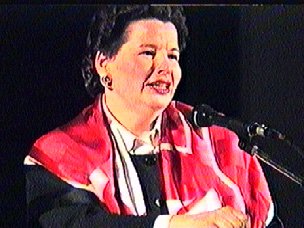 "The "Public" in Public Art"
Introduction I will be talking more about "public" than "public art" tonight. I will be speaking about a public art in the United States that is based in public issues and that demands to be in public, outside the space of the gallery or museum (and their commercial and institutional concerns). The public art to which I refer is rooted in the ideas and character of a place. It is not so much a individual, personal statement, as one that reflects a group consciousness and has a larger cultural resonance. This public art finds its original impulse in traditional cultural manifestations, while its concepts and style are indebted to postmodernist art history and theory. It is an art that draws its subjects from the cultural, economic, social, and political life of the city and to become part of urban life itself. I will demonstrate this by showing the work of artists included in three public exhibitions that I have organized over the past six years which have explored ways in which art could have a more effective place in the public sphere. One of the ways of working in recent decades that has bridged art and life is the genre of installation art which, in its environmental, particularly site-specific aspect, took art away from the solitary gallery experience and brought it into a contextual and, at times, communal one. As a point of reference, I would like to show work which I commissioned by Jannis Kounellis ten years ago while I was Chief Curator at the Museum of Contemporary Art in Chicago. It was Kounellis's four site-specific projects created around the old center of the city, and not his concurrent retrospective at the museum, that best expressed his ideas and brought the public into the work. The power and publicness of Kounellis's projects was achieved through both their subject and their siting. These installations were grounded in a story, that of the European immigrant at the end of the last century_a story the public knew well, either by virtue of having ancestors who had lived through that experience or they themselves having come from other parts of the world. The immigrant story is nearly everyone's story in the United States. The artist's public sites, derelict and abandoned buildings of the 1890s, were essential to the evocation of this history and each site told a chapter in the immigrants' passage from the old world to the new: in a forgotten theatre in a German immigrant men's club, steel panels seemed like a curtain pulled back to reveal the stage and a hidden story of the past; in an industrial building, 42 toy trains whizzed around tracks on each column, metaphorically creating a story of iron and industry. In an adjacent room, a print on the wall featured images of immigrants of the period, while on a sewing machine was draped a piece of paper on which the profile of a young woman had been made with the sewing machine needle. Standing there, the sound of the racing trains was transformed in our minds into the sound of sewing machines, reminding us of the garment sweat shop in which many immigrants labored in the new world; in a former factory Kounellis created a symphony of light, using industrial materials to cover and articulate the light coming through the windows that surrounded the space on all four sides; and in an old warehouse, Kounellis's well-known "Gold Room," a work about the modern existential position, here took on the subject of the mythical, new-world streets paved with gold_the dream of the arriving immigrant. Through recontextualizing his past work in these new locations, the artist devised an itinerary around Chicago that was relevant to the place and the people who lived there. Shared Characteristics of Three Recent Public Exhibitions. I will now discuss three public exhibitions which I have curated since 1991 and which also aim to address the audience of each location. These are: "Places with a Past: New Site-Specific Art in Charleston" for the Spoleto Festival U.S.A. (1991); "Culture in Action: New Public Art in Chicago" for Sculpture Chicago (1991-94); and "Conversations at The Castle" for the Arts Festival of Atlanta on the occasion of the 1996 Centennial Olympics. Each of these programs shared certain characteristics: 1. in each case the artists' projects and the overall curatorial program were developed organically, in unison, challenging each other and changing along the way; 2. these programs responded to the circumstances of the particular city in which it took place, while also confronting the aesthetic and ideological questions of the day; and 3. each program was directed toward the public, that is, a non-art world audience. To reach this group, primary consideration was given to how the public might gain physical and intellectual access to the works; how the art could be meaningful to other people's lives; how art could use the public realm to take on greater meaning than in a gallery context; and how works of art might be made relevant to and have a place in society, and not just within the art world system. 4. each program necessitated that the mechanisms of presenting art and the respective roles of artist, curator, arts agency, funder, critic, and audience be rethought and redefined; 5. each program questioned authority: the authority of written history in Charleston; the authority of the social status quo in Chicago; and the authority of mainstream cultural conventions in Atlanta; and 6. finally, each aimed to reveal our preconceptions about who can be the audience for contemporary art and what is the nature of that audience's experience with art. "Places with a Past." The question at the outset of this exhibition was: whose history? The strategy used to explore this was installation: to use installations as an engaging, environmental mode in which the historical siting of works would illuminate untold chapters of the local history. The subjects dealt with in these projects were offered for public debate by using locations that were free and accessible, and where residents could encounter the projects without having the express purpose of seeing an art exhibition, but rather discover them in the normal course of their day. This program also addressed issues of diversity in the representation of artists and audiences. This was a major issue at that time for museums, as minority artists strove to achieve parity with white artists in the selection of artists for exhibitions. Equally challenging for the institutions was the demand to diversify their audience, making room for minority populations within traditionally elitist institutions. The subjects, artists' roster, and local audience of "Places" made this program more than multicultural tokenism. Here the African-American story was critical to the meaning of the place. This is seen in Houston Conwill's mapping of the "Middle Passage" (the journey of slaves from West Africa to the shores of Charleston, the capital of slavery in North America); the images of agriculture and anger in the sculptures and photographs, words and song of Lorna Simpson; in Ronald Jones's memorial to the slave insurrectionist Denmark Vesey; in Elizabeth Newman's ode to the black nanny and the white children she cared in the nursery of one of eighteenth-century mansions. In Ann Hamilton's 40,000 indigo blue shirts recalling the many unnamed workers in history; and in Joyce Scott's mourning of the souls sacrificed through racism and the evocation of their spirit through sacred, magical objects of healing and hope. Antony Gormley extended the idea of the social institution of slavery to that of enslavement in one's mind and body through a series of seven installations in an 1802 jail. David Hammons dealt with this subject by locating his work in the current-day black ghetto and by creating a community interactive project made in collaboration with residents there. His Charleston-style "single house" (curiously made to be single door wide instead of single room wide) commemorated the community's architectural history and connected it to that of the historic center. His adjacent park, complete with his American flag in Black nationalist colors and a billboard of local children looking up to it (and replacing an illegal cigarette advertisement), was an image of hope for the future of youth. For the audience, this exhibition was one in which they could locate themselves through personal references and see their everyday world differently, even facing the painful part of their history. But from this exhibition, questions of public art practice also arose. Can artists from outside a community deal with the histories of that community and represent others' voices? To what degree can this art convey the needs and concerns of a community? These became important questions for me in my practice, made even more dramatic by the great interest aroused by which Hammons's project with the local community. And so, in my next program I undertook to make that community relationship deeper and more real. "Culture in Action." The overriding question in this program was how to make a public art for today and how to make it as much about the public as about art? What role could the public play in public art and could they be directly involved in contributing to and determining the shape of public art? Would this involvement help to give back to public art some of its cultural power? And, if so, could public art play a constructive role in urban life today? Chicago's own history of public art has two aspects: nineteenth- and early twentieth-century historic monuments, some by the leading artists of the day; and modern masters whose artistic monuments came on the scene with Picasso and Calder in 1968, and continued unchanged through the 1980s with the addition of works by artists like Dubuffet and Miró. My aim was to posit public art in the role of a forum for dialogue and social action: a role more akin to the idea of the plaza than of the sculpture in it. Each artist engaged in a collaborative process with a specific nucleus of individuals_a community as defined by a shared concern or identity. A dialogue was established as the artists' aesthetic interests found a parallel relationship to the constituency's life issues. This was a sustained relationship over about a two-year period. Artistic production arose out of a process of negotiation and exchange, learning from each other, rather than through the imposition of an art object as the artist's statement. All too often in the past a sculpture would be put in a public space unannounced; it would be met with public outcry; and then the situation would be mediated through the press or educational lectures until the debate died down and the objections (as well as sometimes interest) faded away. Here we set up a process that was itself a part of the art. Multi-layered, each project addressed different needs and audiences, had many aspects, and resulted in many actions and manifestations. Taking the notion of audience from that of spectator to participant, this program questioned the definition of social space, the mechanisms of public art, the nature of artistic collaboration, and the relationship of art and social service. Some artists used the public process to create contemporary monuments. Suzanne Lacy organized a network of women throughout the city to designate a diverse group of 100 women to be honored for their contribution to society. Overnight, in Chicago where there were no monuments to women, now there were 100 on the city's main streets in the form of stone boulders with commemorative brass plaques. Christopher Sperandio and Simon Grennan worked with 12 Nestlé factory workers to facilitate their design for a commemorative candy bar recognizing the workers, instead of the company owner; this work also figured at the center of ongoing union labor discussions. Daniel J. Martinez worked with street vendors about to be evicted from the nation's oldest free public market (the land they occupied being appropriated for more upscale uses) and built a temporary people's plaza from massive recycled granite slabs. The living process behind all these projects is perhaps best represented by the work of Mark Dion, the collaborative Haha, and Inigo Manglano-Ovalle. Dion engaged a group of 15 high school students from around the city, bridging ecology and art in weekly classes, a field trip to Belize, and a summer workshop. Haha expanded into a collective of about 50 persons renaming themselves for the occasion "Flood". All the members enlisted in the AIDS healthcare network, while they also each tended a storefront hydroponic garden conceived as an installation, a visual metaphor for the person with AIDS, a safe-sex teaching center, and a center for sharing experiences with the disease and with caregiving. Manglano-Ovalle's project "Street-Level Video" continues to this day as a youth media center. Initially it was an alternative to gang membership; a vehicle for finding ways to talk to one's neighbors_where isolation and fear had been the rule_and to discuss issues of territory, money, housing, race, hatred, and so on; and a tool for Latino youth to represent themselves in contrast to the way the media portrays them. This art was publically accessible art not just by being placed in an open, public space, but by possessing an open concept of participation. It allowed for self-representation_such image-making is the foundation for all art. This art gave hope for empowerment of a marginalized community by recognizing its issues, bringing the citizen and the city closer together in dialogue. It showed that public art does not have to take a permanent form to play a powerful role in the present. Importantly, it demonstrated that art can have a role outside the realm of art and relate directly to a host of urban issues. Thus, it suggested that this direction may be the most significant one for public art today. Again, questions of practice arose, this time from critics who said this work as an affront to the very definition of art. Who is the author in a collaborative exchange? How can persons in a community_outside the art world system_be involved in the making of art? And if they are, doesn't that invalidate the status of the work as "art"? If art addresses and can play a constructive role in dealing with urban issues, by being a healing force or an agent for change, then isn't it social work and not art? And because there was a shift in audience from the usual art elite to the people (il popolo), then wasn't this art "for them and not us"? Now the tide has changed and community-based public art is common. But, as with the proliferation of any kind of art, there are also, lesser examples. I find myself, therefore, criticizing many works because they are one-dimensional, targeted to a single social problem, and because they often have unrealistic expectations and claim demonstrable, remedial outcomes. On the other hand, in spite of its widespread practice, mainstream art criticism will not touch community-based public art. It is still dismissed as something other than art. The lack of critique and integration into the larger, historical thinking about contemporary art is regrettable since criticism could serve a role in the continued development of this public art and offer criteria by which it could be scrutinized. While many shun it, it is interesting to see who embraces this new public art_and why. What needs is this art serving? It is fulfilling a need of artists and communities to find an art with meaning and purpose. For some, it may fulfill a romantic notion of the avant-garde, appearing to be a new form of art outside the established position. But, we cannot overlook the desire on the part of corporations, cultural institutions, and governments to look good, to use this art to seem concerned about the plight of the disadvantaged. Instead of integration and expansion of the idea of art, we are left with the "institutionalization of the marginalized." For example, some museums adopt aspects of community-based practice, just to rename old ways with new, fashionable, and politically correct words. Or a community action can become a "safe" place for a museum to represent a minority artist, rather than in the main exhibition galleries, thus, maintaining the isolation of the fringe elements of society. For philanthropic agencies and corporations, being aligned with the social aims of the artists and their constituencies can "pay off." But such associations can contain and limit the powerful artistic statements that this public art can make. While this art should not be mistaken as a quick solution for social problems, it can have beneficial and constructive effects, most often on an individual level, a few persons at a time. Like the viewing of a painting, it is primarily a public art on a personal level, not a mass experience. But it can also be a motivating critique, a way to see things differently, and to envision change. To do so, this art needs to maintain a critical edge, thus, preventing issues from being neutralized. There is a need for constantly changing strategies. This is not for the purpose of being novel, but rather to be a moving target, to avoid being categorized and absorbed into a co-opting system and being dismissed rather than grappled with, being defused rather than infused with sufficient power to make critique, new thinking, and change possible. "Conversations at The Castle" This program was dedicated to inquiry and discussion. It was aimed to keep the questioning on the surface and make community-based practice into a formulaic relationship between art and the public. I sought to mix questions of community-based art with broader questions of art and audience, both in and out of the gallery space; to show community-based art as part of a continuum of contemporary art practice, in and out of the studio; and to move the discussion of the relationship between art and society away from just being one of "is it art or is it social work?". The questions that arose, in part, grew out of the circumstances of Atlanta in the summer of 1996. How to present an international, contemporary art event in the face of the spectacle of the Olympics? How to add a critical edge to the moment? How to bring about an exchange of cultures, while also including the uninitiated contemporary art viewer? What can be the role of new technologies, particularly the Internet, in relating art to its audience? The strategies employed were simple: to engage persons in one-to-one, direct and personal conversation. We used a single site that would be an attraction itself as the exhibition location, but also as a center (a base of operations and activities, a site of inquiry, a meeting ground). A turn-of-the-century mansion known as The Castle proved the ideal and necessary venue for the exhibition and program. While its historic, domestic spaces were evocative to the artists, the building's intriguing structure and prominent location lured diverse Olympic visitors and Atlanta residents alike. An exterior ramp, which drew people from the street level up to the exhibition's second level and provided handicapped access, provided the program's essential ideas through a series of thought-provoking words selected by cultural theorist Homi K. Bhabha. The seven foreign artists/artists groups participating "Conversations" explored an expanded concept of contemporary art in public space, as well as modes of personal and cultural communication. While those whose work is based in studio practice (Regina Frank from Germany, Irwin from Slovenia in collaboration with Russian artists, and Yukinori Yanagi from Japan) were challenged to find ways to open up the work to visitor participation that would further the resolution of the work; those who developed their work through residencies in Atlanta (Ery Camara from Senegal, Mauricio Dias and Walter Riedweg from Brazil/Switzerland, Maurice O'Connell from Ireland, and "artway of thinking"/Federica Thiene and Stefania Mantovani from Italy) had to also find ways to bring that experience with specific community groups into the gallery and make its meaningful to others. We did not take the view that to engage a wide public, the program must be simplified; we did not offer a marketing sound-bytes; we did not provide answers. We offered a chance to talk about and think about a complex of ideas, a network of issues in art and society at an individual level. The public presence of the artists at The Castle daily, as well as through their community interactions, added a human dimension to the work that made the resulting installations accessible and more appreciated. The art experience, even though it took place in a public setting, was one that touched audience members on an intensely personal level. It was the participatory, interactive aspects of these projects that made them work in all their complexity of form and subject. Regina Frank created a performance installation which she occupied for most of the summer, communicating via the Internet with visitors on the opposite side of a glass wall; their messages were converted into virtual beads on the screen, corresponding to actual ones in the installation which the artist sewed into a Magic Mantle; this kimonolike paper garment, made from shredded books that had figured importantly in the artist's life, became now a cloth of communication with others. Irwin staged an installation and then with five Russian colleagues set off in two mobile homes to stage conversations in other artists in centers around the U.S. to talk about their concept of art in their communities; summaries of these discussions were sent via the Internet back to Atlanta. Yanagi made a reverse design of the United Nations symbol_the world see from the southern hemisphere_which became the outdoor discussion space for the public at The Castle, a place for the world to meet. Camara in the African-American community of Reynoldstown, Dias and Riedwig at a youth prison and federal penitentiary, and O'Connell at a Boys and Girls Club, each dealt with issues of disadvantaged populations. They developed these people's relationship to art as a means of communication to the larger society_art as a way of having a conversation with others. Finally, Thiene and Mantovani facilitated a two-week series of dinner-discussions among local and national arts persons around the many intellectual_social and aesthetic_issues which "Conversations at The Castle" aimed to expose. This was the culmination of this think-tank experience as the summer's public interactions were analyzed as a way of making these theoretical dinner conversations more concrete. Conclusion How can art be a real part of our society? Ours is culture of commercial systems defined by white, upper-middle class connoisseurship and collecting patterns, and museum-going. Our rituals and social practices include attending openings and lectures on art. Art is not a crucial force in the way the general public lives their lives, but only of concern for those whose vocation or avocation is art. We have struggled throughout the twentieth century to restore a relationship between art and life, whether it be in the manner of Dada, Beuys's social sculpture, or recent community-based art, to name but a few ways. I do not present community-based, site-related, urban-specific art as the new way to adopt, because I resist the concept of stylistic progression that would imply in this case. We are in a state of flux in thinking about art and our society and its relation to the public. We must resist offering "new answers" and instead keep probing what are the new questions. And so I end with asking you_the audience_what is the question for you? Why do you make art? Why is art important in your lives? Why is it necessary? What can it do in Italy today? Does it have a relationship, for instance, to your immigrant poor? How does art represent who you are? And how does it relate to the other parts of your private and public life? |
||

|  |