|
Buona sera. I can't do this very well in Italian, because I don't know much Italian, but io sono stata qui in Italia la prima volta 20 anni fa, sono venuta con un treno, seconda classe, da Belgrado a Milano, ma questa θ la prima volta da 20 anni che sto qui a Milano. (I was in Italy for the first time 20 years ago, I came by second class train from Belgrade to Milan, but this is the first time I've been to Milan in 20 years). So, this is all I can say in Italian. I'll try to speak simply in English and we have a translator.
When I was invited to make this conference about my work, I decided not to show only my own work. If you have been working 25 years, like I have, you find it extremely boring to talk only about your own work, again and again and again. I find it so interesting when artists just show stuff they like. Sometimes it tells so much more about the artist than if he just shows his own work.
My main interest throughout all these years of work has always been concentrated on the human body. And during this time I've made a collection of lots of different video tapes, not only of performances, but also theatre, dance, film and music — all people working on the body. This is what I would like to share with you tonight. I don't think it will be boring because in the 70s, you know, performance artists made all these long, boring performances of many, many hours. But now we are in MTV time, so I make editions of these tapes in 30 seconds, one minute, two minutes — five minutes is a very long time.
First, I propose that the people who are standing really should sit, so maybe the young ones can sit down here in front of me, because it's really much more relaxing to see the tapes sitting down. Okay? (audience moves to front to sit). Good, these are better conditions, great.
Okay, let me start first with a little story.
Some years ago I went to Ladakh in India. One of the main reasons for me to go to Ladakh was to see the Lama dancing. The Lama dances are ritualistic dances where the dancers put on animal masks and dance for one week, every day from sunrise to sunset, non-stop. It takes an extremely strong mental and physical condition to do this. I heard there was going to be a Lama dance in a small monastery, and I went ten days ahead of time to see the preparations. When I arrived there I found eight monks. One was very small with a really fat stomach. Others were middle aged, skinny, a few were younger, but they all were in extremely bad physical condition. They'd been doing rehearsals in very slow speeds — three steps here, a step there, a bit of drumming — but most of the time they were just eating.
Then the day of the Lama dance arrived, and more than 3000 people from all over Ladakh, plus foreigners, came to see it. I absolutely didn't believe that these kinds of people could do any dance. Everybody woke up very early in the morning, we sat down in a circle, waiting for the sunrise — that's the moment when the Lama dance starts. The drummers were ready, the drumming began, the dancers came out, and that small fat monk stood completely motionless in the centre of the circle. Then the sun rose. At this moment, the little fat monk sprang from the earth, jumped three feet into the air and completed three salti mortali (somersaults), and comes back down without even changing the speed of his breathing. And the rest of the monks started dancing all week from sunrise to sunset, with the most incredible physical demands.
So this story explains very much what is a performance, what is happening when the performance artist steps into a mental and physical construction he made himself, in front of his public.
Like that little fat monk, once he puts the goat mask on his face he's no longer that little fat monk, he is the god he represents. There's this important moment when you actually transit from your ordinary self into your superior self. And that's the moment when the energy of the public plays an extremely important role. So that's this moment when you actually enter into an energy dialogue with the public.
So let's start with some visual material now. I would like to start with a very short and very ironical statement about the role of the artist by Gilbert & George. Because there are as many ideas about what art is supposed to be as there are artists. Let's see what Gilbert & George have to say, yeah?
(Video by Gilbert & George. Excerpt from text: "I'm fascinated by the fabric, by the richness of the world... Beauty is my art. I believe in the art, the beauty and the life of the artist, the artist as an eccentric person. I uphold traditional values...")
Okay. These different statements like "beauty is my art" are not the only views of artists. I think that art has to be disturbing. And art has to really show the new way how society should think. And you know, every artist is different, like Beuys thought that artists have to be shamans, and Malevich thought that artists have to be in the new step, and Mondrian thought that artists have to present a "true" reality. And Yves Klein thought of his paintings as the mere ashes of his art, he believed in the process, as I do. Because I think that in performance the process is the most important thing, because in the end, when it's finished, you just go home with a memory.
It's interesting how the body of the artist can be a metaphor and can symbolise many different things. I want to dedicate the first part of my talk tonight to the artist's head. So, please put the second tape on.
The head of the artist has played an important role for a long, long time since the early 50s. So one of the first things I'll show you is the work of a young artist from Spain, she just made her head into an object, like a nature morte, a still life... a work by Picasso. This is actually part of an installation, the monitor just lays on the floor with the still life head in the space.
The next piece is actually very historical. It's Vito Acconci, who worked a lot in Italy, probably many of you know about him. Vito Acconci was one of the first artists in the early 70s who gave the name Body Art to Body Art. He made a few performances for the public, but the works of his that are more important is a series called Home Movies, where the public is actually absent, but he works with video, thinking of the public. One of the most classical pieces from this series that I like is called "The Cowboy". He very simply tells the story of the cowboy, using only his head.
(Video of Acconci's head. While he tells the cowboy story in a trance-like voice, his hands more or less mimic the actions of the cowboy on his horse, in gunfights, with women, moving over his face like a landscape. Excerpt from text: "I'd stop for a while, stop there in that town, there were things for me to do there, but I knew myself, I knew a gunfighter couldn't rest..." Vito's finger's "walk" over his face, he slaps himself and grabs at the skin of his cheeks, etc.)
The next piece is later. That was a 70s piece but this next one is from the 80s. This piece comes from a very different background. This is the Keersmaekers, a Belgian dance group. So they come from a dance tradition, and the piece is called "Monolog", and it works only with the head.
(Video runs. A girl's head fills the frame. She begins speaking angrily, moving her head in a jerky way. As she grows angier, her movements become jerkier, more abrupt and angry. Finally, her voice is cut out, and dramatic classical music takes over, while her head, screaming, moves back and forth angrily in slow motion...).
We should know that in all these cases the artist's head is the subject and the object at the same time.
Many times we see similar ideas coming from different artists at the same time, let's call it Spirit of the Time, like in the next two video tapes. One is by Rebecca Horn, and the second is mine, and both deal with the idea of the serpent, the mythological snake. Only, in Horn's piece the snakes are scissors, snakes represented in the form of scissors, and the actor is telling the story of the love and lives of two snakes. And in my case, the snakes are real. Let's look at them.
(Rebecca Horn's video involves a young Rebecca who chops her hair off mechanically, with two pairs of scissors, while a man at her side recounts in a rather factual way this tale of two snakes. Text is in German).
Now, the next one is the performance "Dragon Head" when I had five snakes on my body, mostly pythons and boa constrictors. In this video you only see the one snake, which weighed about 25 kilos. The duration of this piece was one hour, and I had the floor of the space covered in ice blocks. So the heat of the body kept the snakes on my body and protected the public, because they won't go on ice.
(video runs: a very large snake is wrapped around Marina's head. It moves, slithers, over her face. Its tail forms itself to the hollow between Marina's eye and nose. Marina remains motionless).
The next three pieces are very young artists, because it's interesting to see how this new generation deals with their heads. The first is a Swiss artist, Pascalle Grau; she works with the idea of violent feeding, you know, like when you are getting food by violence.
(video of a young woman jamming her fist into her mouth, her head circles on the screen and her hand is almost completely stuffed in her mouth).
This continued until that she reached the point that she could not stand the position of her hand in her mouth any longer. And in a way the head became a kind of sculptural installation in the space.
The next two are even younger artists, I'm talking 22, 23, 24 years old. First is Iris Selke, she's a German — both are German, actually.
(video of a woman staring hard at her reflection in a mirror, until finally she smashes her head into and the mirror breaks).
The second is by Frank Werner. This piece was done with a super-8 camera, which was fixed in a space, and he tried to face his own body limits of making pirouettes.
(video of young man spinning. All we see is his head turning and turning and turning, occasionally it disappears, and we know he has fallen down).
So we have three more head pieces until we finish the section on heads.
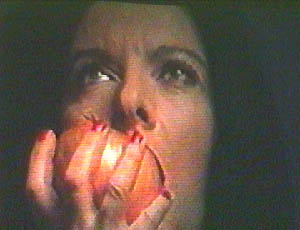
I'd like to show you one of my new pieces, it's about two years old. It's called "The Onion". I'm very proud of the title, it's so domestic. The story is very simple: I'm eating the biggest onion I can find and complaining about my life. Of course, the onion has a symbol of its own: it's made of layers, like life. I will show you the beginning of the tape, then fast forward to the end, to see how it works, because to eat this onion I require eight minutes and that's too long for this lecture. I think this is a religious piece: I'm looking up and the sky is blue.
(Tape runs. We see Marina's head against a sky-blue background, holding a large, raw, unpeeled onion in front of her. She bites it, text begins: "I'm tired of changing planes so often, waiting in airports, in train stations, in bus stations, I'm tired of waiting for endless passport controls...")
In performance there is a process, there is always a beginning, middle and end, so we had to rush through that video. And so on and so on.
("I'm tired of more and more career decisions, museum and gallery openings, standing around with a glass of plain water, pretending that I'm interested in conversation. I'm so tired of my migraine attacks..." By the end of the video, onion almost finished, her eyes are streaming with tears, her nose is running, she's a mess, because of the onion).
The next video is by a young British artist. She made a performance in a night-club, because night-clubs in England are now the places for performance, like galleries and museums were in the 70s. She actually kisses her partner while very violently shifting two microphones in their mouths back and forth between each other's mouths. It's called "Kiss".
(Hayley Newman, "Kiss", 1994: a young couple makes out passionately, even violently, near the banisters on the balcony in a night-club. The mics transmit a loud, chaotic clacking noise).
Okay. I'd like to finish the head section as I started, with a small head piece by Gilbert & George. I hope you know that these artists actually declared themselves as living sculpture, so in that way it's not just performance but a piece of living sculpture at the same time.
(Gilbert & George face each other. One sticks out his tongue and the other opens his mouth wide and screams until his breath runs out. Then they switch roles. This continues, alternating back and forth, ad infinitum.)
Now let's go to the next part of the body. I think this part is funny, and that's the breast. Here in Italy there is such appreciation of the big breast, so I think you'll understand the humour. But there are artists working with this theme, and all of them that I have on my list are women.
I'll start with a young Greek artist. The piece is called "Just Above". She got first prize in an international lesbian festival last month with this piece.
(the artist is Ewjenia Tsanana: Girl jogs up a long staircase. The camera focuses in on her bouncing breasts. She reaches the rooftop. Shirtless now, she holds her hands over her breasts. When she releases them, the bounce straight upwards, defying gravity).
The next one comes from a dance background, and it was made in one of the workshops I've been doing in Brittany, France. One of the conditions before my students make a work is five days without talking and five days without eating anything, just drinking lots of water. What is important is to make a work of art using nothing except your own body. She made this piece in the forest — "The Hunt". What's that in Italian? Oh yeah, "La Caccia". "La Chasse" in French, that's the title. The public had to follow her through the forest and transform into hunters.
(video runs, the artist is Susan Omen — it is a view from the "animal's" perspective, a camera fastened somewhere around the groin region shows two hanging, bouncing breasts, as the artist run on her hands and knees through the forest).
So the next one is a very Catholic piece by a German young artist. With humour.
(video runs — a gold cross on a chain swings back and forth between two trussed breasts in beat with music).
I taped the next one myself from German television. It's just a small reportage about the woman with the biggest breasts in the world, and not only does she have the biggest breasts in the world, but she wants to make them bigger.
It's very interesting how the body is becoming more and more sculptural material, because in the performance art of the early 70s, the body was material where things happen — as Vito Acconci said, the body is a place, a site. Most of the time we used the naked body as the most natural and direct means and tried to push our own mental and physical limits using that body.
I've been to see lots of operations in hospitals, like brain, heart and spine surgery, each one longer than a few hours. I was interested: What is the body? And the same material used to make tables is used in operations to make the body —hammers, screws, wires and so on. It's interesting now how the development of plastic surgery has turned the body into some kind of strange, grotesque sculptural material.
(video runs — an attractive Asian girl with breasts the size of big watermelons, or larger, is interviewed and displayed. Pretend nurses, also very sexy, inspect her breasts with a stethoscope, etc.).
We just saw a quick clip of Greta Garbo after the woman with the large breasts, but of course that's another story.
Okay, now we've past the section on the breast, and we go to another section: this is the section of danger and violence in performance work, or not just performance, but art in general. Let's start with a classic: "Le Chien Andalou", an Andalusian Dog. Buρuel's mother funded the making of this film.
(Film runs, but stops after the eye is cut in that famous scene).
Okay, but this was a film: now let's go to the real stuff.
One of artists who pushed limits the most in Body Art in the early 70s was definitely Chris Burden. The most violent action on himself was when he asked a friend to come to the gallery with a rifle and shoot through his arm. The commentary on this piece I'd like to do later. First I want you to see the work. Just to say something about the documentary material: this piece was very important and impossible to repeat, Burden had no financial means in those days to properly record his work. So it's very interesting how he actually showed this piece years later, putting together a documentation made of very poor material. It's basically a soundtrack from a small tape recorder, then eight seconds of film shot by a super-8.
(Viewing of "Shoot" by Chris Burden, 1971. We hear the words "Do you know where you're going to stand, Bruce?" "Are you ready?" Then the click as the camera begins to roll. We see Chris Burden shot in the arm, then walking away from the wall, clutching his arm. After the screen turns black, we hear the empty shell drop on the floor.)
Again, I want to just go on with this kind of work and comment at the end.
The next film is a documentary film about ritual cuttings in Togo.
(We see as young tribesmen and women are engraved on the face, back, etc.)
Next are two pieces of mine, one is called "Rhitan Ten" and one is called "Lips of Thomas". And it's the same idea of pushing body limits.
(In "Rhitan Ten", Marina Abramovic plays the game where she jabs a knife repeatedly in a board between her stretched out fingers. She moved faster and faster, occasionally cutting herself. In "Lips of Thomas", Abramovic cuts a big star into her belly. The star, very large around her bellybutton, begins to bleed).
The third piece is not exactly inspired directly by "Chien Andalou", but does deal with the human eye. I had lots of difficulties making this piece in America because I had to find someone who would do it, holding the needle for me. Here it is, it's called "In Between".
(video of a needle circling very, very close to Abramovic's eye for a long period...)
So you've just seen all these rather violent things. I have to say something about them.
In our lives we always do things we like and we absolutely don't like or hate to do things we don't like. Easy choice, isn't it? But at the same time we find ourselves never moving outside of our own patterns. We are meeting the same people, we are falling in love with the same types of people, we are making the same mistakes over, and over, and over again. The only way to get out of this pattern is to do things you are afraid of, you've never done before, you don't know and you don't like.
One of the biggest fears is of course the fear of dying, and we push those thoughts of death out of the way. If we see some tragic deaths on television we'd rather switch to something more pleasant. But we have finally to accept that death is a part of daily life. Only pushing yourself beyond your limits is a way to liberate yourself from dying.
There is a Tibetan tradition where the monks, in order to liberate themselves from fear of dying go and sleep with a dead corpse at the cemetery. And at different states of decomposition too: two days dead, three days dead, when the corpse begins to be eaten by worms, when the flesh falls off the bones, when the bones turn to dust. Aborigines and people in Togo and other places in Africa, so-called "primitive" cultures — I'm being ironical — have similar rituals pushing limits.
Why do they perform such cuttings on the skin, involving so much pain? Why do Aborigines go into the desert to experience something called "clinical death" and come back?
Because only when you really confront yourself with this pain, fear of dying, your physical limits, can you actually free yourself from it.
So the rituals of these cultures are a kind of frame in which we, the performers, can stand in, watch, participate, enact, in order to arrive at something called a mental jump to another state of reality. And we performance artists in the early 70s became interested in the same kinds of problems. We don't have a body of rituals or beliefs behind us like the Aborigines or Africans do. We have a different set of symbols and different means. We are living in cities, cut off from nature altogether. That's why Chris Burden used a rifle instead of a stone knife.
I would like to show you a small piece, part of an exercise I did with students in Germany. I asked them to bring three minutes of the music they hate. Not the music they like but the music they hate. One French girl, Julie, made this piece about the music she hates. It's very short, using the body.
(video runs — with a soundtrack of some kind of horrible New Wave ballad, early 80s type music — a crude human figure made out of dough is cut up, sliced, wrapped in cloth, and stabbed with pins).
Now, something completely different. I'd like to show you the best performance of this century. And who is the actor in this? It's your own Pope from the Vatican. I don't think any of you have ever seen such material. This is the story: in 1976 John Paul, Giovanni Paolo, was invited to come to the US for the first time. He was invited to talk at Madison Square Gardens to the Youth of America, young kids and students of America. They asked him if they could call him Holy Daddy but he said no. The Youth of America gave him different presents, like an electric guitar, jeans and T-shirts, and so on. Thousands of kids gathered in Madison Square Gardens to listen to his speech. He made something extraordinary. This piece is seven minutes long and you have to see it through completely, because it's not possible to cut any second out of it. The intervention of the Pope was transmitted live over national TV. When he started doing what he did they got so panicked they actually cut the program live on air in the middle, and put on advertisements. I had a friend working in this studio and she actually made me a copy of this tape in the panic of the studio, so that is why I have this very bad quality but the only existing version of the show. I'll just show you from the presentation of the last present so you can get a feel of the event, and then it moves onto the performance. But I'm serious, it's the best performance I've ever seen from this century.
(video runs. Music is blaring, the Pope sits after receiving his last present. The crowd is wild with cheering. After many minutes of listening to the cheers and smiling, the Pope starts to make noises into the microphone: "Whoooo... whoooo! whoooo! Mmmmmm.... whoooo.....". This goes on for several minutes, while the crowd goes wilder, chanting "We love the Pope!" John Paul turns to the Cardinals on stage with him and says "A charismatic moment." He continues making noise for several minutes: "Whhhhoooooo...". Finally the camera cuts to the Cardinals, who all look very nervous, talking amongst themselves. One Cardinal goes to the Pope and hands him a note. The Pope makes a funny face at the camera and waves. He says: "Whooooo!". Then he holds up his hand, pointing at the sky. He says to the crowd: "You know, you know? You know what it is? You know... We shall destroy the program!" Tape ends).
Alright, so I have an interpretation of this. It's very important that in the middle of all this he said, "a charismatic moment." In Eastern way of thought there are three ways of teaching. The first, the most ordinary way, is what I'm doing here now, talking to you. Second is when I'm making voices, abstract voices. So, una comunicazione con suono solo.(A communcation with sound alone). And the third way is when the student stands in front of the teacher in silence. Questo θ comunicazione telepatica solo. (This is purely telepathic communication).
The Pope used this second way of communicating. Why? He comes to America to speak to the Youth of America in the 70s, and they have no patience to hear another boring Holy speech. By working with sound alone he was able to get much closer to them than he would have through any speech. But it's very rare that a political or religious leader of this type would have the courage to use this approach in front of the media.
Now we're running out of time, though I'd like to show you more. So let's just jump to dance. It's very short. I'd like to show you two pieces by Pina Bausch. What I like about Pina Bausch is that her approach to that is very similar to that of a performance artist. She puts her dancers in real situations — naked in the snow, under water or under tight mental constrictions or demands. I'll show you two very short pieces that are very rare, not many people know them. One is very interesting because it uses something very contemporary. And the other has a feeling of water-colour.
(The video runs: in the first, an dancer stands against the wall, agitated, as a small remote control model airplane buzzes around her head and body. In the second, "Image in the Bath", the dance takes place in a transparent tub full of water).
Another thing by Pina Bausch is the opening of a film for TV. Her idea is that everything is dance. Dance is running, dance is sitting, dance is standing, dance is smoking, dance is doing nothing. This is the opening scene of a film.
(video runs: Dancer dances with a leaf-blower in a forest. Dancer dressed like a Playboy bunny stumbles, as if drunk, on a hill of dirt...)
So the next thing is someone I like very much because of her drama and she is the only person who died and the doctors said she died because her heart was broken because of love. Very few performances of hers were recorded. She's electric, charismatic, but at the same time a little girl: Maria Callas. I'm not going to show you Maria Callas because of her singing. I'm going to show her because of how she received her applause after her singing. Like a golden shower. And I was talking earlier about when an artist steps into his own physical and mental construction to do a performance. At this point he leaves his ordinary self and reaches his superior self, like a Lama dancer. Then Callas finishes singing, and there's a passage from her superior self back to her ordinary self, and you see this transformation during the applause. She's both people at the same time.
(video runs. Callas finishes singing and meets great applause. She courtesys and boys and waves and thanks people, becoming ever more agitated and less glamorous).
The applause is 15 minutes long, a long time, and she becomes more and more a little girl.
Now, the last two things I'd like to show you. It's interesting to see this transition between art and real life. I can only speak of my own experiences.
You know I worked together with an artist named Ulay for twelve years. We were born on the same day and we had a very strong relationship. It happened that everything finished and we decided to end it all by walking along the Great Wall of China. He started from the Gobi Desert, I started from the Yellow Sea. After two and a half thousand kilometres walking we met and said goodbye. It was a very painful moment in my life. After this I had a very strong crisis as an artist and as a woman. But an artist always works with his tragedies, his pain. Somebody once even made an analysis that said that the worse an artist's relationship was with his family, the better the artist's work. Somehow, we need drama to work things out. We become the mirror image and the audience can project their own problems onto us. The only way I could deal with my pain was to stage my life like a theatre play, called "The Biography". I want to show you the last scene of "The Biography", where I also use Maria Callas's music — who else could I use? And this is the moment when Ulay is in the audience being his real self and I am on the stage acting out our lives and I am saying goodbye to different things.
(video begins: Marina is on a small stage, dressed glamorously. She holds up one arm to wave goodbye and says, slowly: "Bye-bye, Extremes. Bye-bye, Purity. Bye-bye, Togetherness. Bye-bye, Intensity. Bye-bye, Jealously. Bye-bye, Structure. Bye-bye, Tibetans. Bye-bye, Danger. Bye-bye, Unhappiness. Bye-bye, Solitude. Bye-bye, Tears. Bye-bye, Ulay.")
So, the last thing I'd like to show tonight, to end this evening, it's another drama. It's Gloria Swanson in Sunset Boulevard. She's just killed her young lover and she thinks she's going to make another movie but she's actually going to the madhouse. Where life and movies come together and everything becomes one thing.
(The final scene of Sunset Boulevard is played).
Grazie. Buona sera.
|