|
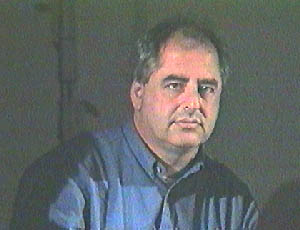
Good afternoon. I must apologise for not speaking in Italian.
What I want to do this evening is to show you two films that I've made, and then to discuss in some detail the structure and the way that I ended up making one of those films. I'm very aware that one has to treat artists talking about their own work with great suspicion, because it's one thing to make the work but another to have an interpretation of it after the event. What will be the most useful is to show the two films, and then to talk about one film in detail. Then, as a test, as it were, I will show that film again so you can measure what I've said against what you see.
The first film, "History of the Main Complaint", is about four minutes long, and the second, "Felix in Exile", is nine minutes long. I won't say anything about them first, so we can begin now.
(Viewing of "History of the Main Complaint".)
"History of the Main Complaint" was made in 1995. The next film, "Felix in Exile", was made a year and a half earlier in 1994. The only thing I'll tell you about this is to remind you that 1994 was the time of the first general elections in South Africa. And this is the film I'll talk about in detail.
(Viewing of "Felix in Exile".)
I would like to trace backwards the origins of this film and describe how it was made. Because if we are talking about narrative in this series of talks, "Facts and Fiction," then I'm interested in how this work ended up as a narrative, because it certainly didn't begin as a narrative. But the most practical thing to do is just to describe how the film was made.
A traditional animated film has thousands of different drawings. The way I work is not to have thousands of different drawings, but to make hundreds of alterations on just a few drawings. In my studio there is a sheet of paper, one meter and a half by one metre, on the wall of the studio. And in the middle of the studio there is a movie camera and the making of the film is a walk, a continuous walk between the drawing and the camera. So, for example, there will be a drawing of a body lying on the ground, and I'll do the drawing, then I'll walk to the camera and shoot maybe two frames of this image, about one twelfth of a second. Then I walk back to the drawing and start rubbing out a piece of newsprint covering the body, maybe enlarging it a bit. I walk back to the camera and shoot another two frames. So that each sequence of the film is one drawing, but a drawing that's been changed, erased and added to dozens or hundreds of times.
One of the results of this, which you may have seen already and will see again later when we watch the film a second time, is that although it's been rubbed out one can't get rid of all traces of the previous drawing. So in each drawing you have a trace, somewhat like the trace a snail leaves behind it, of every stage, every development of the drawing. Built into the very process itself and into the drawings then is a notion of the passing of time, of the trace of time, of history. That's the first point I would make, that within the very technique of my films is part of the work's meaning as a whole.
For example, I worked for a while on a piece of computer animation, and what a computer does very well is copy and manipulate and change images, but it can also store and repeat images many times, so the heart of that project became a question of repetition and multiplication. But in the films you have just seen the question of the passing of time or the accumulation of history is built into the chalk, the charcoal and the eraser.
With "Felix in Exile", as with other films, there's no script or storyboard. It's not that I don't want to write a script, but it's just that if I try to write a script in advance I end up with an empty sheet of paper in front of me. The only way I can start a film is to begin with one or two key images I have in my head, which I then draw and animate. Having done this I then look at them on an editing table when they come back from the laboratory, and from what those images suggest I will start working forwards and backwards, expanding the front and the tail of the film.
I think that this is just a personal attribute. Some people are capable of sitting down and having a coherent thought, and at the end of the hour their thought or decision has moved from one point to another, and they've made progress. But I find, with myself, if I sit down and simply try to think, my brain just goes into neutral, nothing happens. For my brain to start functioning it requires physical, practical activity. It's only from the actual activity of making these drawings, making marks on a sheet of paper, that ideas will emerge both about the drawing I'm doing and also about other connections, other possible drawings that could come before or after that could be developed.
With "Felix in Exile" the starting points, the first images on the sheet of paper, came from a number of different sources. The first is a word game. I know it is a very Anglo-Saxon thing to play with words, to play with "Felix" and "exile", which are almost anagrams of themselves. I was aware that to say, "Let's start a project on the basis of this word play," might make a really weak basis for a project, but for me it is an entry point. The important thing is to have this point of entry and then you hope that once you've entered, once the first marks are made, other ideas which may be more significant may begin to take over.
A second starting point was the image I had in my head of a person shaving in a mirror, and shaving away his reflection. I don't know if this was a dream image or where it came from, but it was an image I had and with this image came the phrase: "I will not survive my life." This was another starting point. I thought, "There's something you can start drawing, and once it is drawn you can see what it means." And in fact, this wasn't the first image I drew but I left this image as a reserve. I thought, "If I get stuck in case of emergency I could always draw this image of a man shaving and his image disappearing, so I'll keep that as a reserve image to work with." And in the end, as you saw, it is a part of the film, but it is not the central part of the film, it's a side-track. It became a very useful way of bringing the man and the woman together, but that I didn't know at the start.
Those were two important starting points: "Felix in Exile" as a word game, and the image of someone shaving and his face disappearing. But the third one that got me going came from a friend who was making a documentary on the history of Soweto. He told me he'd come across some extraordinary police photographs of people lying dead in the veld, of people who'd been murdered or shot, lying in the veld. And without seeing these photographs, I thought these could be images I could draw. And in my head I'd seen these photographs of people lying in a large, open space, but when I actually saw the photos themselves they were very different, they were people in corridors, people lying in small spaces. In fact, none of them were out in the veld.
If I had actually seen the photographs first I probably would not have made this connection to people lying out in the landscape, but because they'd been described to me as bodies in the veld it charged me and set me off saying, "Well, what's happening in this direction?" So when I actually started making the film I started with these bodies lying out in the veld. The photos I was shown were terrifying photos, but the moment I started drawing them a different process or something else happened in terms of what it was to look at them. And when I come to talk about the landscape I'll talk about a similar process, but what struck me here, what became interesting, was the way in which making drawings of the images, the activity of drawing, in a way tamed the images, made them manageable, made the events they were describing graspable. I think a point I would make has to do with the way that drawing something is a way of controlling it. Maybe not in real life but in the life of one's head. In terms of trying to control different problems of my life, I would say that drawing is rooted quite deeply.
Now, I'd just like to do a side-track here to talk a little bit biographically, which does relate to both these films. And this is the fact that I'm a white South African. From the mid-1950s until now I have always lived in Johannesburg. Obviously these have been violent times and there have been a number of key events in South African history over the last forty years. One of them was a very large massacre outside Sharpville, which is a town near Johannesburg, where 69 black protesters were shot by the police. At the time my father was one of the lawyers for the families of the people who had been killed. This was at the inquest, in 1961, when I was six years old. I remember coming once into his study and seeing on his desk a large, flat yellow box - it was a Kodak box - and lifting the lid off of it. It looked like a chocolate box. Inside were images of a woman with her back blown off, someone with only half her head visible. The impact of seeing these images when I was six years old for the first time - the shock was extraordinary. I understood that the world was not how I had imagined it at all, that things happened in the world that were inconceivable. So I would say that although when I was drawing the bodies for "Felix in Exile" I did not have the Sharpville massacre in mind - this was only a connection I made some months or years later - I'm sure that in a sense it was partly to try to tame that horror of seeing those images that I made these drawings.
In the same way, about a year or so earlier I had been driving in a car with my grandfather, and out of the side window I saw two men kicking a third man on the edge of the road, which was also for me a shocking image of violence. I mention this because that image comes into the first film you saw, "History of the Main Complaint."
To go back to the drawings of the bodies: there's obviously the reference back to Sharpville, but the particular images that I chose to draw - because I drew maybe only eight out of hundreds of photos - were very close to images I'd seen in classical paintings, in Renaissance paintings. So that, for example, one of them reminded me of one of the figures of Goya, from the "3rd of May", of a person lying on the ground. And one of the other police photos of a person shot in 1992 I saw today at Brera, in the Mantegna painting of the foreshortened "Dead Christ". I realised that what had made me choose that image to draw was this connection. So there's a whole complicated art historical overlay that also sits on one's head.
I had a proper schizophrenic situation - I had a word game, "Felix in Exile", I had a memory of Sharpville violence and images of recent violence in Soweto, and I had the tradition of depicting violence in Western art, all as points on the map of the film as it was being made. And it all had to come together to make sense.
At the end of the first week or two weeks there was maybe one minute of film. There was a man being covered by a newspaper, there were other figures disappearing in the landscape. There was the figure of the woman who had appeared in one of the drawings. And at the end of two weeks I put these pieces of animation together on the editing table, and then it was a question of trying to see what the drawings I had already done suggested for other drawings. And from there on the process becomes almost secondary.
It appeared that the woman in the film needed to have a much larger role and appear throughout the film. It became clear that the person shaving would be a way to link the person in the room, Felix, with Nandi, the woman outside of the room - that could be the moment, the closest moment of contact. It becomes a question of tact. How close? How far? How much of this scene? Do you want to see this person earlier? Do we need a connection from one scene to the next? But in the end the narrative becomes not necessarily secondary but a structure in which to reveal, in which to show, on which to develop those other elements that came before it and, whether I knew it or not, may have been the reason for making the film, which had to do with what is it to draw these bodies disappearing in the ground.
Now, the second part of the film, which has to do with bodies and landscape, leads me to want to talk about the landscape, which is also in a sense a biographical diversion.
I grew up, as I told you, in Johannesburg, which is in an area of South Africa known as the highveld, 2000 metres above sea level and very dry and featureless. There are no rivers, there are no mountains and no trees. Throughout my childhood I felt I had been cheated out of a landscape, that is to say, the landscape, the countryside I lived in, didn't look anything like the countryside described by the English children's books I read. I remember also being given a book by my grandfather which was called "Great Landscapes of the World". There was a Constable, an "Aayurain" with lots of big trees and water, and a Courbet of water again and forest. So there was a feeling of feeling of, "Well, why do we have to live here with no landscape? Why are we no good that we have to live here in the Transvaal which is not where the world is?"
One of the central features of the landscape around Johannesburg is that it is man-made. What defines the shape and the structures are the old bits of mine that are there, sections of civil engineering, bridges that have been abandoned, drainpipes. The only mountains that existed on that landscape were the artificial hills created by digging gold; the ground that was dug up was piled into these mountains. Everything in the landscape itself referred to a social past, something that had been done in that space in the past, because in fact most of those mines have ceased to exist and even the mine dumps themselves are disappearing because mine companies are finding they can turn the dumps into mud and extract more gold, and even that familiar landscape, those mountains are disappearing, leaving less of a varied landscape.
When I was a child drawing landscapes, which is what children do, the landscapes I drew were the exact opposite of the one where I lived, and it was only when I was around about thirty that I began drawing this other landscape, but with a type of anger, as a revenge against that landscape. And that of course transformed my way of seeing the landscape, because now I love driving around that landscape, the countryside around Johannesburg, because it all presents itself to me as a potential drawing. This was the landscape in which I was interested in putting these bodies - of course because this is the landscape of Soweto, but also because it was a landscape quite charged with how I felt towards it, my relationship to it. So what became clear was that my interest in the landscape or how I understood the landscape was almost archaeological, a process of finding traces in the landscape. These traces did two things: they pointed to the history that had taken place in the landscape but also became a way of structuring a drawing formally. And so to make drawings of this landscape was to make an archaeological map of places where different social interventions had taken place. That shadow running across the page was not just a natural shadow, it was a place where a ditch had been dug at some point.
So it was very much a sense of drawing a social or historical landscape. But there is a way in which the process of doing that drawing found that history, because the landscape itself hides that history. I mean this in a very specific way. I would say it is the nature of terrain or ground to gradually eradicate all traces of what happens there. There's a way in which the grand landscape traditions take the landscape out of time, in that they represent nature as this eternally beautiful, brilliant thing. This is very different from how I saw nature, which was very much as a historical, changing, impermanent object.
To give a very concrete example: say you have an area like the Katyn forest in Poland which was the site of the massacre of thousands of Russian officers at the start of World War II. What you see if you see photos of this piece of ground now are forests which have grown and maybe an area where the trees are slightly straighter than the other trees around them. There's a way in which the landscape itself is hiding in a very literal way its history. If you simply look at that landscape and don't try to decode it you have lost a sense of what happened on that terrain. And so what I claim is that the landscape - the landscape itself, not in paintings but outside in the real world - is a metaphor for how memory works, in the way that landscapes over time obliterate what has happened there in the same way that memory is unable to hang on to events that have passed.
So to do a drawing of someone being absorbed by the landscape is to refer to several things about how the landscape hides or absorbs the history of what's happened on it, and also to refer to the way our own minds have such a difficult time hanging on to things that have happened in the past. And we need very concrete things to jolt us - that's why we have museums, memorials and monuments, to try and stop the process of forgetting. And in "Felix in Exile" the question of drawing the landscape and memory became the centre, the real core that kept me drawing and drawing that film. I was interested in recording the people, both the people I'd seen in those photos and the people who died in the first general elections in Soweto, but I was in a sense also giving a burial to the people I'd seen in the photos when I was a child. To both give a burial to those people and also to make a beacon against the process of forgetting the way in which we got to our recent past in South Africa.
Thank you. I think that's my interpretation after the event, looking backwards. I think it will be useful to watch the film again. If there are questions afterwards we can discuss them.
(Final viewing of "Felix in Exile").
Q: Are the traces you leave in your drawings, which underline an idea of memory, something that you've always consciously included in your work?
A: I discovered it really when I started drawing, when I tried very hard at first to erase all the traces of the previous drawing. I thought it was a fault or a weakness that there was a trace of the previous drawings. Later, when I watched the drawings on film - not in these films but in much earlier films - I understood that those traces were a gain and not a loss, and so from then on I still rub out hard but it doesn't distress me that you see the root.
Q: If there are no storyboards for your animations, was there a screenplay for your theatre pieces?
A: With the theatre pieces I've tried to start the way I would when doing a drawing, so that the starting point is not a finished script. The starting points are key images in the middle. I would work with a writer and we would find those key images, and work outwards. But the final script is an end product and not a starting point.
Q: Can you talk a little about the soundtracks for your films?
A: Ah, yes. The music is something I didn't talk about but that I should talk about. The way I would work is that after two weeks or so I would look at the first material for the animation on an editing table. At that stage I would listen to wide range of different music to see what kinds of music worked with the images and what different music did for the images. You can imagine that different music changes the images enormously, not only in terms of the emotional charge given to the images but actually in terms of how you see the images. With certain music, because the animation is very rough, sometimes the music makes it too rough even to look at. But with other music the exact same images suddenly become very smooth. And you cannot believe your eyes, actually looking at the same frames of film. So, for example, with "Felix in Exile" I knew I wanted a voice for the woman, I wanted a sound of the woman, and I knew I needed a kind of music that would work with the landscape. And for the one I worked with a singer I liked very much and asked her to suggest pieces she could sing. For the landscape I spoke to a composer who wrote music for the film. With the first film that you saw, "History of the Main Complaint", it was somewhat different. There I wanted to see if Monteverdi's music and the images inside the body had a relationship that could work, and that was partly in response to another project, an opera production of Monteverdi's "Il ritorno d'Ulisse".
Q: You say that the dead bodies become watchable or manageable in the drawings. I would add that they are also very beautiful. I wonder if you are aware of this fascination, this tension, or if you are concerned throughout your work whether Life or Death will win?
A: I think that's a very interesting question and not one that I've put to myself before. When actually drawing the bodies, as I've said, there's a change from looking at the photographs, which are really horrifying. Because what drawing is, really, is a very stupid, dumb and practical process. It's a question of laying down large areas of charcoal, of retracting some, putting down more, asking yourself, "Does that arm look heavy enough? No, it's too light, it's shape is wrong"... and one is lost in a whole series of practical questions of the event, and one forgets about what the images actually mean. In a sense, the meaning can only be revealed when the drawing is finished. So, in honesty, I can't really answer your question.
Q: It really strikes me that there are no boundaries between the bodies and the landscape, the voices and the music in "Felix in Exile". This is really nice. Was it difficult to arrive at?
A: The question of the continuation of the bodies into the landscape, I think in this film I was partly interested in the lack of boundaries, about how history will absorb all those bodies. Obviously there's a big difference in this film between Nandi - the woman who we see as the person drawing her history, the cartographer of her own history, measuring history, and in the end being caught by her own history - and the others. We see her initially as an alive person and only at the end as part of the landscape, there is obviously a clear separation. With the other figures who begin in the landscape, I was interested in how the figures would be absorbed. So for me it became very important at a certain point that they were not all simply figures that disappeared into the landscape, and that's why the woman in the film grew from being a dead body, which is where she started, and grew into a live person with a whole trajectory in that film.
Q: Your main images, your "key images", as you call them, are often quite surreal. What's your relationship to surrealism?
A: There are elements of the way in which the surrealists worked that appeal to me, but their way of saying "Let chance take over" - creating meaning or not through haphazardness from things that are there purely by chance, this being the heart of the work - this I am not very interested in. I am interested in work that is neither programmatic, that is neither following a script nor is haphazard but somehow in-between, such as the things that would be suggested by those word games. They are not random word games, they are phrases which have a weight because they seem to refer to other parts of the world. They are like radar signals of something else, a way of getting to something else rather than an end in themselves.
Q: At the Sexta Bienal de la Habana you used animated film mixed with real television footage. Why did you use TV images for this work?
A: This is a question about the mix of drawn images and archival. I think I should maybe show people a bit of this work on tape - I have a copy here. This was a piece done for a piece of theatre, projected onto a screen, and the piece of theatre combined written material with documentary material, so the question for the animation was also whether drawn images could work with archival images. This is from a play called "UBU and the Truth Commission", and uses a different animation technique: lots of little paper cut-outs under the camera. And we'll just look at a section of it which mixes documentary and animated images.
(Video begins of "UBU and the Truth Commission" but sound doesn't work.)
This is a piece shown sometimes independently as a video project but sometimes in an installation with other material. What I was trying to find out here was how close can one put two very different ways of seeing or representing the world - video images and this very schematic animation made using cardboard cut-outs - without the one destroying the other. And it's quite difficult to tell right now because we don't have any sound, but I think it can work, the two modes can reinforce and strengthen each other.
Q: I'd like to know something more about symbolism in your work, and symbols like water...
A: I'd say that, like other meanings in my work, it begins with the drawing and later I find the meaning, but Johannesburg is characterised by having no water around it so images of water are always images of beneficence, of comfort. A pool of water in Johannesburg is a luxury.
Q: What's your relationship to the written word?
A: Um, I have a good relationship with the written word (Laughter).
I rely a lot on written notes, rather than sketches, so for example I don't make notes through drawings when I work, I write things down. I would write down: "a man shaving and his face disappearing," rather than make a sketch of it.
Q: In general, erasing is used to cancel an error, but you use it to actually construct your films. Have you ever felt bad about erasing a particularly good drawing in the process of making a film?
A: I would love to say, "No, I have a purity of spirit that lets everything be destroyed, as it must," but that would be false. Occasionally, what I will do is remember in my head midpoint an image and simply reconstruct it later. And in one or two cases I've actually done a cut-away, like a close-up, so that I can move onto another drawing. So there is one sense in which the films themselves are a very complicated and ridiculous way at arriving at a set of drawings. But it's very clear that if I become too precious about a drawing, it becomes very tentative and weak, and the animation itself shows the bad faith that is happening there.
|